Count Zero View as Markdown Review ★ ★ ★ ★ ★
Count Zero , by William Gibson , is the second book in the Sprawl series. It follows three strangers—a teenage hacker on his first run, a mercenary hired to extract a defecting scientist, and an art dealer tracking down mysterious boxes—as they’re pulled into a struggle between zaibatsus, the ultra-rich, and something stranger.
I’ve been on a bit of a cyberpunk kick recently. I started Snow Crash Snow Crash by Neal Stephenson ★ ★ ★ ★ ☆ Snow Crash , by Neal Stephenson , is a satirical cyberpunk novel set in a near-future America where the federal government has collapsed and everything—pizza, religion, neighborhoods, national defense—is run by competing franchises. It follows Hiro Protagonist, a hacker and pizza delivery driver, and Y.T. , a teenage skateboard courier, as they uncover a conspiracy to reprogram the human mind.Neuromancer Neuromancer by William Gibson ★ ★ ★ ★ ★ Sprawl #1Neuromancer , by William Gibson , is the first book in the Sprawl series, and one of the founding texts of cyberpunk. In it, Case, a hacker who can’t jack in anymore, and street samurai Molly Millions are hired by a mysterious ex-special forces agent to pull off a heist.Stephenson ’slove Gibson ’s writing, so I was excited to pick up the Sprawl
Power Revisited Count Zero takes place 8 years after Neuromancer Neuromancer by William Gibson ★ ★ ★ ★ ★ Sprawl #1Neuromancer , by William Gibson , is the first book in the Sprawl series, and one of the founding texts of cyberpunk. In it, Case, a hacker who can’t jack in anymore, and street samurai Molly Millions are hired by a mysterious ex-special forces agent to pull off a heist.feels more real. The characters are smaller, just trying to survive in a newly transhuman world. Bobby Newmark, the eponymous Count Zero , is just a teen who hopes to be a cowboy someday; his first run almost kills him. Case in Neuromancer Neuromancer by William Gibson ★ ★ ★ ★ ★ Sprawl #1Neuromancer , by William Gibson , is the first book in the Sprawl series, and one of the founding texts of cyberpunk. In it, Case, a hacker who can’t jack in anymore, and street samurai Molly Millions are hired by a mysterious ex-special forces agent to pull off a heist.also a loser—he’s a druggy trying to get the street to kill him because he’s too scared to kill himself—but he is a cowboy, he’s good at his job, a vital part of the team. He’s an anti-hero whereas Bobby isn’t even that. Marly Krushkova doesn’t have augmented vision or blades in her fingers; she sells art. Turner, the emotionally damaged mercenary, is the closest to a bad-ass who would have fit in Neuromancer Neuromancer by William Gibson ★ ★ ★ ★ ★ Sprawl #1Neuromancer , by William Gibson , is the first book in the Sprawl series, and one of the founding texts of cyberpunk. In it, Case, a hacker who can’t jack in anymore, and street samurai Molly Millions are hired by a mysterious ex-special forces agent to pull off a heist.Gibson sets it up brilliantly: he gives Turner’s team backstories, a meticulous plan… and then blows it away. Everyone’s gone, none of their planning mattered. The characters in Count Zero spend a lot of time in the dirt instead of in orbit: hiding in abandoned malls, crawling through the Appalachian mountains, hanging out in the projects. It makes the world feel alive in a way it didn’t in Neuromancer Neuromancer by William Gibson ★ ★ ★ ★ ★ Sprawl #1Neuromancer , by William Gibson , is the first book in the Sprawl series, and one of the founding texts of cyberpunk. In it, Case, a hacker who can’t jack in anymore, and street samurai Molly Millions are hired by a mysterious ex-special forces agent to pull off a heist.
Neuromancer Neuromancer by William Gibson ★ ★ ★ ★ ★ Sprawl #1Neuromancer , by William Gibson , is the first book in the Sprawl series, and one of the founding texts of cyberpunk. In it, Case, a hacker who can’t jack in anymore, and street samurai Molly Millions are hired by a mysterious ex-special forces agent to pull off a heist.Count Zero views the same power from the outside. The zaibatsus tower over the plot, so high up they can’t see the people they’re crushing. Above them is the world’s richest man, Josef Virek, dying of some fast-growing cancer and playing the zaibatsus against each other, trying to find a way to “jump” to the next evolutionary step. He has already lost his humanity, even before the jump, as Gibson makes clear when Marly meets Virek’s simstim avatar:
And, for an instant, she stared directly into those soft blue eyes and knew, with an instinctive mammalian certainty, that the exceedingly rich were no longer even remotely human.
But the heroes, the zaibatsus, and Virek are all human-scale power, even if they’ve left their humanity behind. Wintermute and Neuromancer were also on this scale: they were comprehensible. But at the end of Neuromancer Neuromancer by William Gibson ★ ★ ★ ★ ★ Sprawl #1Neuromancer , by William Gibson , is the first book in the Sprawl series, and one of the founding texts of cyberpunk. In it, Case, a hacker who can’t jack in anymore, and street samurai Molly Millions are hired by a mysterious ex-special forces agent to pull off a heist.Gibson handles that incomprehensible power the way humans have for millennia: religion. The fragments of the AI appear to the humans as Loa from Haitian Vodou . And they behave the same way, possessing mortals and riding them.
Punk Influenced Count Zero deepens the connection between Gibson ’s Sprawl Stephenson ’sSnow Crash Snow Crash by Neal Stephenson ★ ★ ★ ★ ☆ Snow Crash , by Neal Stephenson , is a satirical cyberpunk novel set in a near-future America where the federal government has collapsed and everything—pizza, religion, neighborhoods, national defense—is run by competing franchises. It follows Hiro Protagonist, a hacker and pizza delivery driver, and Y.T. , a teenage skateboard courier, as they uncover a conspiracy to reprogram the human mind.Neal Stephenson Neuromancer Neuromancer by William Gibson ★ ★ ★ ★ ★ Sprawl #1Neuromancer , by William Gibson , is the first book in the Sprawl series, and one of the founding texts of cyberpunk. In it, Case, a hacker who can’t jack in anymore, and street samurai Molly Millions are hired by a mysterious ex-special forces agent to pull off a heist.Gibson ’s work all along. Angela’s brain was modified to allow her to connect to the divine, similar to Enki’s nam-shub. She speaks in Haitian Creole when communing with the divine, which other characters liken to speaking in tongues, just as Rife’s followers do. Both use religion as a parallel system to technology. There are some smaller similarities too: the pontoon town off LA is like the raft, the slamhound is similar to the rat thing, the Orthodox Scientologists with Hubbard as a saint are just like the Pearly Gates franchise with Jesus, Elvis, and Reverend Wayne.
Count Zero reminded me of many other works. Structurally, the helpless protagonists at the mercy of forces they don’t understand recall Watts ’sEchopraxia Echopraxia by Peter Watts ★ ★ ★ ★ ★ Firefall #2Echopraxia , by Peter Watts , is the second book in the Firefall series, unfolding at roughly the same time as Blindsight . It follows parasitologist Daniel Brüks, who gets unwillingly dragged into a conflict between multiple transhuman factions, travels to the Icarus station orbiting the sun, and eventually back to Earth.Alex ’sA Mote in Shadow A Mote in Shadow by A. N. Alex ★ ★ ★ ★ ★ A Mote in Shadow is A. N. Alex ’s debut novel. It follows two down-on-their-luck outsiders dragged into a war between shadowy mercenary groups: exobiologist Chaeyoung No, whose disagreement with the scientific establishment leaves her in no position to question a too-good-to-be-true offer to fund her research expedition; and space hauler Frederik Obialo, who is more than willing to take a dangerous job if it brings him closer to his dream of giving his daughter a permanent home.Gibson ’s trick of investing you in a story only to rip it away is one Banks Matter Matter by Iain M. Banks ★ ★ ★ ☆ ☆ Culture #8Matter , by Iain M. Banks , is the eighth book in the Culture series. It begins with a tale of betrayal in an early-industrial kingdom housed within a shellworld, and ends with the unleashing of a cosmic horror.
The world-building details are familiar: the zaibatsu-loyalty enzyme acts like Ketracel-white from Deep Space Nine , while the collapsed food chain and krill wafers are Soylent Green . Turner’s extraction team, with a cyberspace cowboy riding shotgun, mirrors the mages in Williams ’sMetropolitan Black Mirror or the Hound from Bradbury ’sFahrenheit 451 Fahrenheit 451 by Ray Bradbury ★ ★ ★ ☆ ☆ Fahrenheit 451 , by Ray Bradbury , is a classic novel about the homogenization of mass media and our collective flight from intellectual challenge. It follows Guy Montag, a fireman who burns books for a living, as he slowly realizes he must stop.
Virek’s autonomous wealth, sometimes at war with itself, was like the corporations-as-code in Stross ’sAccelerando Accelerando by Charles Stross ★ ★ ☆ ☆ ☆ Accelerando , by Charles Stross , is a hard sci-fi fix-up novel. Originally published as 9 separate stories, it follows 3 generations of the Macx family as they upload, fork, merge, and scatter across a solar system slowly being converted into computronium.The Matrix .
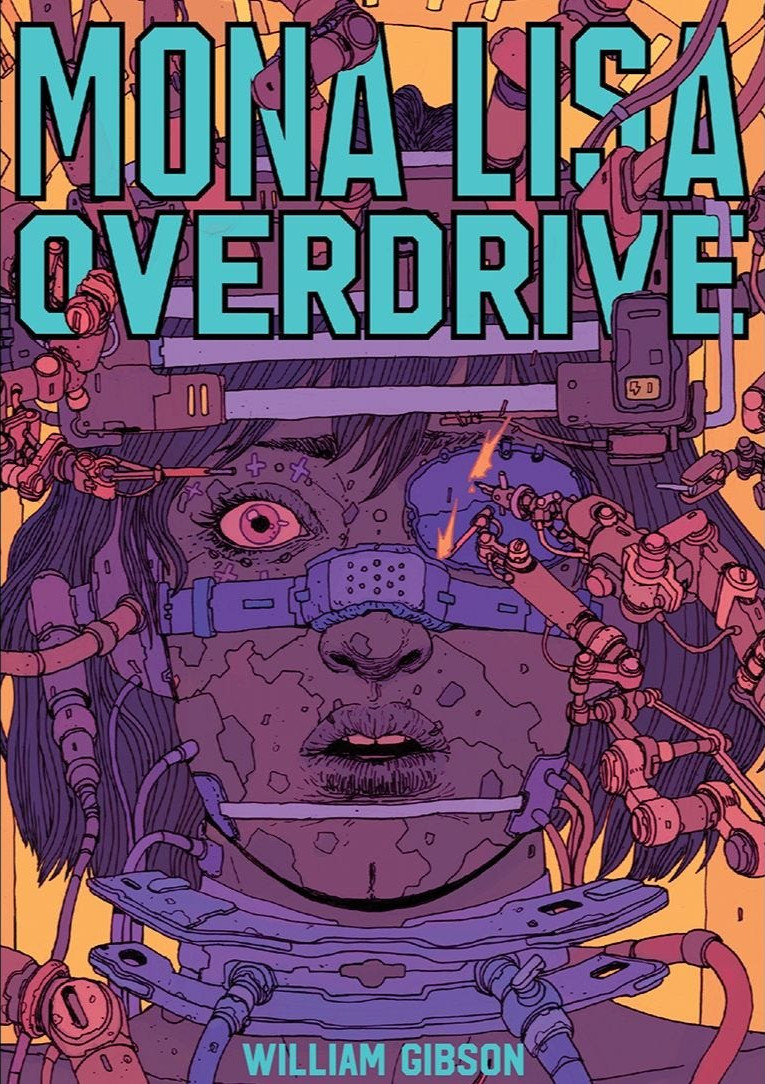
I’m always nervous picking up the second book of an author I just discovered, worried they’ll break my heart. Count Zero put those fears to rest. William Gibson writes such short, energetic prose that sweeps me along, and his character work is extraordinary: everyone feels different, but alive. I’m looking forward to Mona Lisa Overdrive Mona Lisa Overdrive by William Gibson ★ ★ ★ ★ ★ Sprawl #3Mona Lisa Overdrive , by William Gibson , is the third and final book in the Sprawl series. It brings together characters from both previous books—Molly, Angela, Bobby, and the ghost of 3Jane—around a device that can hold the entirety of cyberspace, and maybe a human soul.