This Is How You Lose the Time War
Review
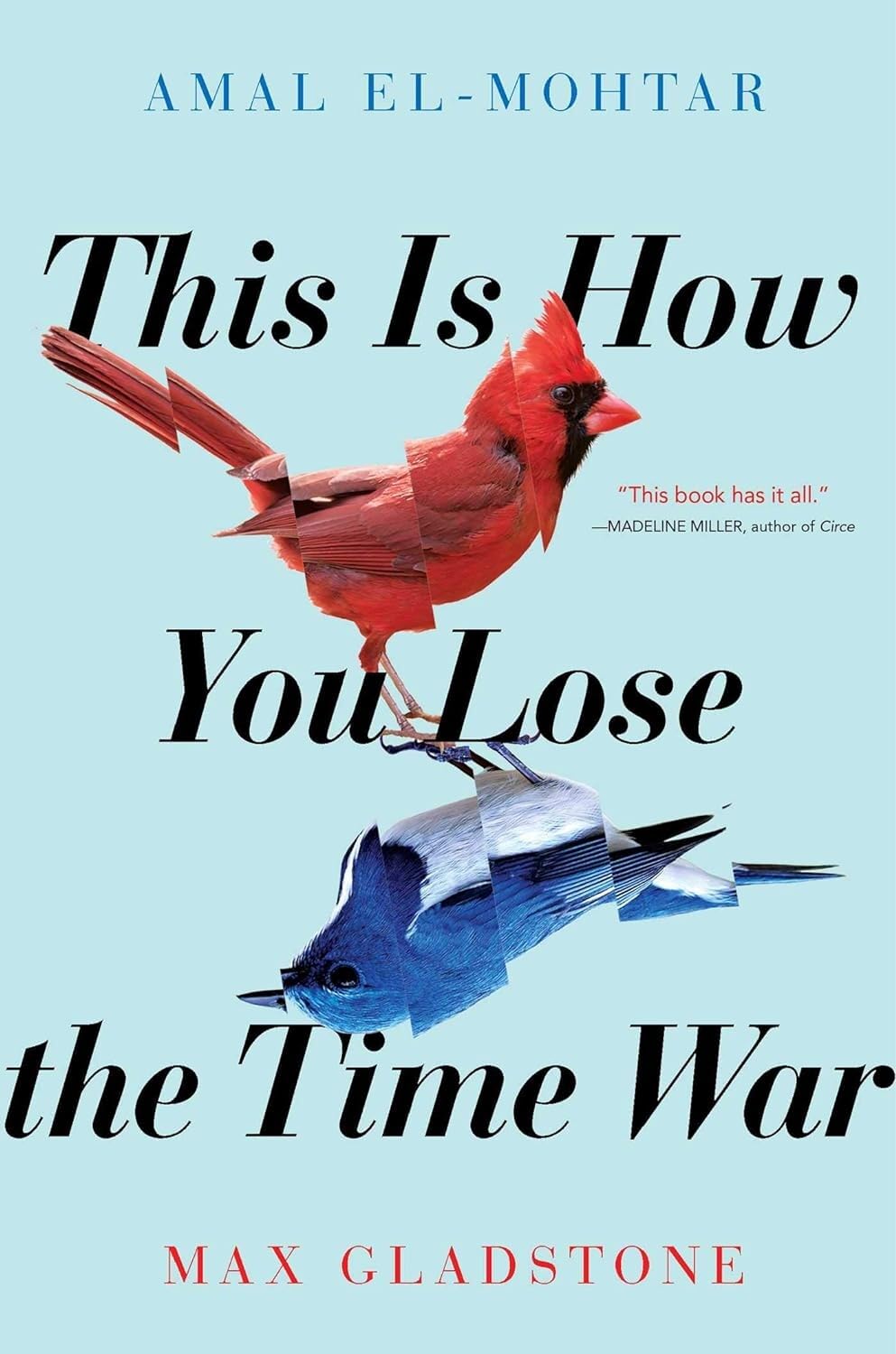
This Is How You Lose the Time War, by and , is a story about two agents—Red and Blue—working for opposite factions from the far future, changing the past in an attempt to wipe out the other side.
This Is How You Lose the Time War was incredible at capturing a feeling, using its prose and characters to make me remember what it was like to fall in love. But once I finished it, that feeling collapsed and the book kind of disappeared from my mind. That’s not what normally happens. Most of the time I think about a book for days after I finish it, and for some rare ones—The Book of the New Sun, Firefall, and the Culture—years.
I think that’s because This Is How You Lose the Time War relies so heavily on the relationship, and intentionally hollows out the setting to bring Red and Blue into sharp focus. You don’t need to know much about the war, about the Agency or Garden, or about the logic of their current missions, because it is all pointless. The war is unending. It can’t be won. The only thing that matters is the feelings Red and Blue have for each other.
In that way, This Is How You Lose the Time War is kind of the structural opposite of the Jean le Flambeur series or House of Suns. Those books were almost entirely carried by elaborate worldbuilding, where the characters, the plot, and even the writing were less important than the novelty of the setting. They suffered heavily for it. This book does away with most of the setting and plot to focus entirely on the characters and the prose. It works better, but it still leaves the book feeling a little incomplete. Those books are all brain, this book is all soul; you need both.
This Is How You Lose the Time War also references a lot of other works: ’s Travel Light, ’s Ulysses, ’s The Odyssey, ’s Ozymandias, ’s The Second Coming, and ’s epitaph (also heavily referenced by in Hyperion).
The prose in This Is How You Lose the Time War reminded me of ’s A Memory Called Empire. The constant references to pop culture felt like ’s Ready Player One. The secret war that most people are oblivious to was similar to ’s There Is No Antimemetics Division. The fighting through time was like the Shrike and Moneta in ’s Hyperion. The wide variety of combat methods and settings reminded me of Use of Weapons and Surface Detail. Blue going undercover as an apothecary was like Inversions, and the authors’ use of wild settings reminded me of how uses places in the Culture series in general. The letter that kills reminded me of the Bene Gesserit and their power words in ’s Dune. Red being able to disable part of herself so her controllers wouldn’t know what she’s doing is like Murderbot from ’s The Murderbot Diaries.
Next up are The Fall of Hyperion, Endymion, and The Rise of Endymion. I put off finishing the series the last time I read it, but this time I’m going to make it through. I’ve already started my re-read of The Fall of Hyperion, and it’s even better than I remember. I’m excited to see where the series goes.