Roadside Picnic View as Markdown Review ★ ★ ★ ★ ☆
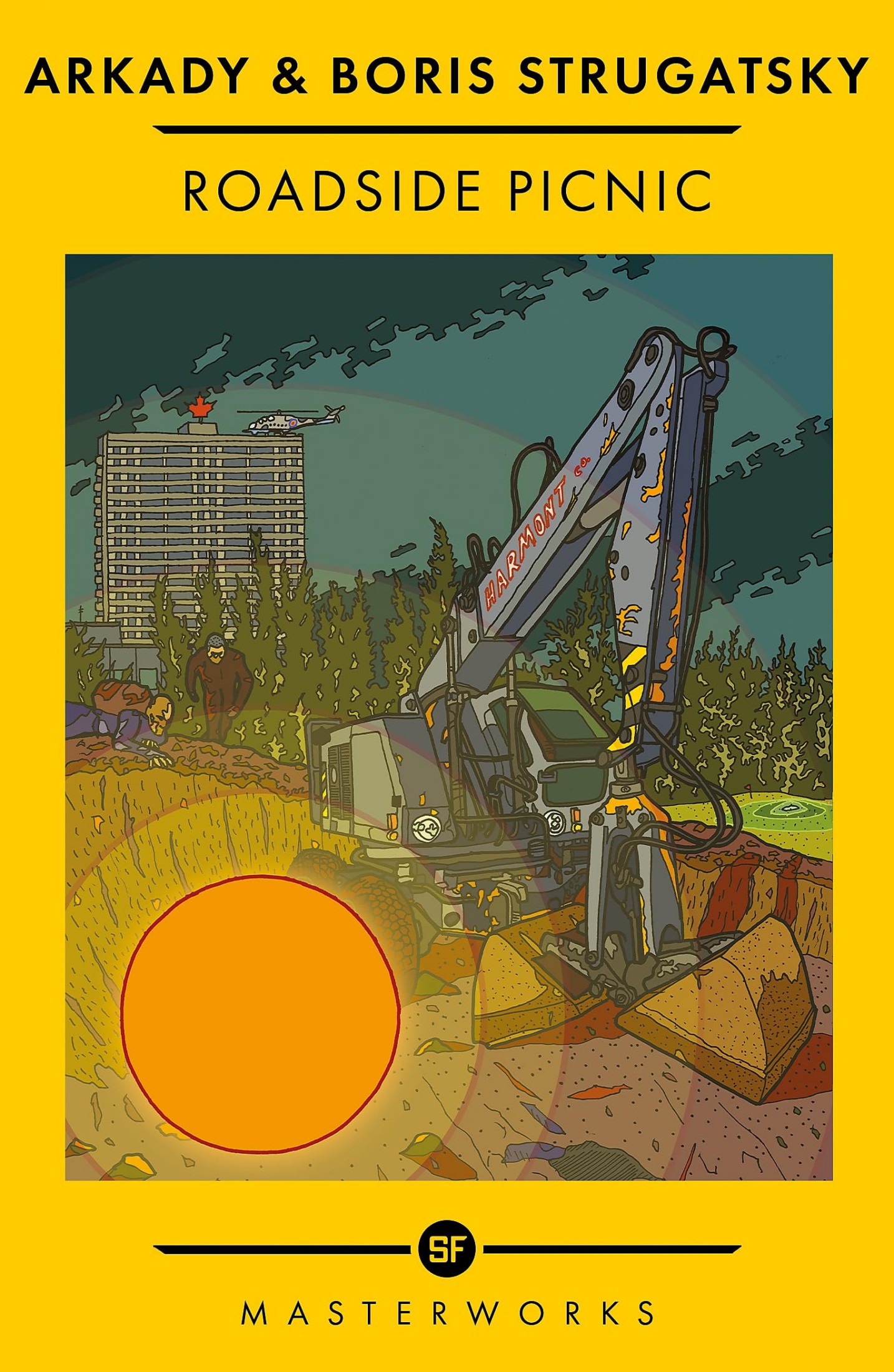
Roadside Picnic , by brothers Arkady and Boris Strugatsky , is a Soviet sci-fi novel. It’s essentially four short stories—each presented as a chapter—about the life of Redrick “Red” Schuhart, a “stalker” who illegally enters an alien-contaminated Zone to retrieve items for the black market.
Roadside Picnic is a first-contact story like The War of the Worlds The War of the Worlds by H. G. Wells ★ ★ ★ ☆ ☆ The War of the Worlds , by H. G. Wells , is a landmark science fiction novel. It takes place in late Victorian England as an unnamed narrator witnesses a terrifying invasion by Martians with advanced weaponry.The Three-Body Problem The Three-Body Problem by Liu Cixin ★ ☆ ☆ ☆ ☆ Remembrance of Earth's Past #1The Three-Body Problem was recommended as a exciting, hard-scifi book full of new ideas. I was eager to read it, having just gotten back into fiction. I bought it for my flight from Melbourne to San Francisco and I threw it in the airport trash as I got off the plane.Roadside Picnic is closer to Blindsight Blindsight by Peter Watts ★ ★ ★ ★ ★ Firefall #1Blindsight is a hard sci-fi novel about first contact with aliens in the near future. A crew of four transhumans and a vampire are sent on a spaceship to investigate an anomaly in the solar system after a swarm of alien probes scan Earth.Echopraxia Echopraxia by Peter Watts ★ ★ ★ ★ ★ Firefall #2Echopraxia , by Peter Watts , is the second book in the Firefall series, unfolding at roughly the same time as Blindsight . It follows parasitologist Daniel Brüks, who gets unwillingly dragged into a conflict between multiple transhuman factions, travels to the Icarus station orbiting the sun, and eventually back to Earth.completely alien, not even conscious in the human sense, yet operating on a level far beyond our understanding.
Tied into this theme is our inability to understand; that some things are unknown and unknowable. Arkady and Boris never give the reader any more information than the characters have, and they never show us the aliens. They don’t even hint at what the Visitors might be like, other than by showing us the incomprehensible items they left behind. Humans have no better chance of understanding an Empty or the Golden Sphere than an ant has of understanding a nuclear reactor. Red’s daughter, the Monkey, fits this theme too, becoming more and more alien as she grows older and losing the ability to understand her parents at all.
Arkady and Boris Strugatsky make the Zone feel dangerous and oppressive without overdoing it. We only see the inside of the Zone twice: once at the very start, when Red takes Dr. Kirill Panov to collect a full Empty, and again at the end, when Red sacrifices Arthur to the grinder to make a wish at the Golden Sphere. But the Zone looms over the entire novel, always feeling like it’s about to erupt from the pages.
Roadside Picnic pays homage to H. G. Wells ’sThe War of the Worlds The War of the Worlds by H. G. Wells ★ ★ ★ ☆ ☆ The War of the Worlds , by H. G. Wells , is a landmark science fiction novel. It takes place in late Victorian England as an unnamed narrator witnesses a terrifying invasion by Martians with advanced weaponry.H. G. Wells ’s
Roadside Picnic reminded me of other works. The institute trying to contain and study the Zone’s artifacts is similar to the SCP Foundation from qntm ’sThere Is No Antimemetics Division There Is No Antimemetics Division by qntm ★ ★ ★ ★ ★ There Is No Antimemetics Division , by qntm , is a book about researchers trying to control dangerous antimemes—ideas that can’t be thought—and how you might combat a foe you can’t even remember exists.Disco Elysium Disco Elysium by Robert Kurvitz et al. ★ ★ ★ ★ ★ Elysium #2Disco Elysium , written by Robert Kurvitz et al. , is a role-playing game produced by ZA/UM. It’s the story of Harrier “Harry” Du Bois, a man who wakes up with no memories and has to solve a murder while learning who he is.Iain M. Banks ’sCleaning Up The State of the Art by Iain M. Banks ★ ★ ★ ☆ ☆ Culture #4The State of the Art is a collection of short stories by Iain M. Banks . It contains some stories related to the Culture universe and some general science fiction tales. Although it has been considered utopian fiction, it comes across as rather bleak.The State of the Art The State of the Art by Iain M. Banks ★ ★ ★ ☆ ☆ Culture #4The State of the Art is a collection of short stories by Iain M. Banks . It contains some stories related to the Culture universe and some general science fiction tales. Although it has been considered utopian fiction, it comes across as rather bleak.Alan Moore and Dave Gibbons ’s Watchmen .
I really enjoyed Roadside Picnic , and I’ll definitely be reading more of Arkady and Boris Strugatsky ’s work. Their style feels so different from the American and British sci-fi I’m used to that it provides a nice change of pace. Next up: The Unconquerable The Unconquerable by S. M. Stirling et al. ★ ★ ★ ★ ☆ Bolo #11The Unconquerable is the eleventh book in the Bolo series. As an anthology from seven different authors, it serves as a direct follow-up to the previous collection. The stories continue some established character arcs while also introducing new enemies, new ideas about Bolo capabilities, and the galaxy-altering conflict that would define the end of the Concordiat era.Hyperion Hyperion by Dan Simmons ★ ★ ★ ★ ★ Hyperion Cantos #1Hyperion is Dan Simmons ’s masterpiece. It is the first book in his Hyperion Cantos . It follows seven pilgrims as they travel to the Time Tombs on Hyperion to petition the Shrike. Along the way, each tells their own story, weaving together history, myth, and prophecy to tell of the impending downfall of man.Not Till We Are Lost Not Till We Are Lost by Dennis E. Taylor ★ ★ ★ ☆ ☆ Bobiverse #5Not Till We Are Lost , by Dennis E. Taylor , is the fifth book in the Bobiverse series. It sets up the Quiniverse, introduces a Skippy AI, and explores the discovery of wormhole travel.