Red Rising
Review
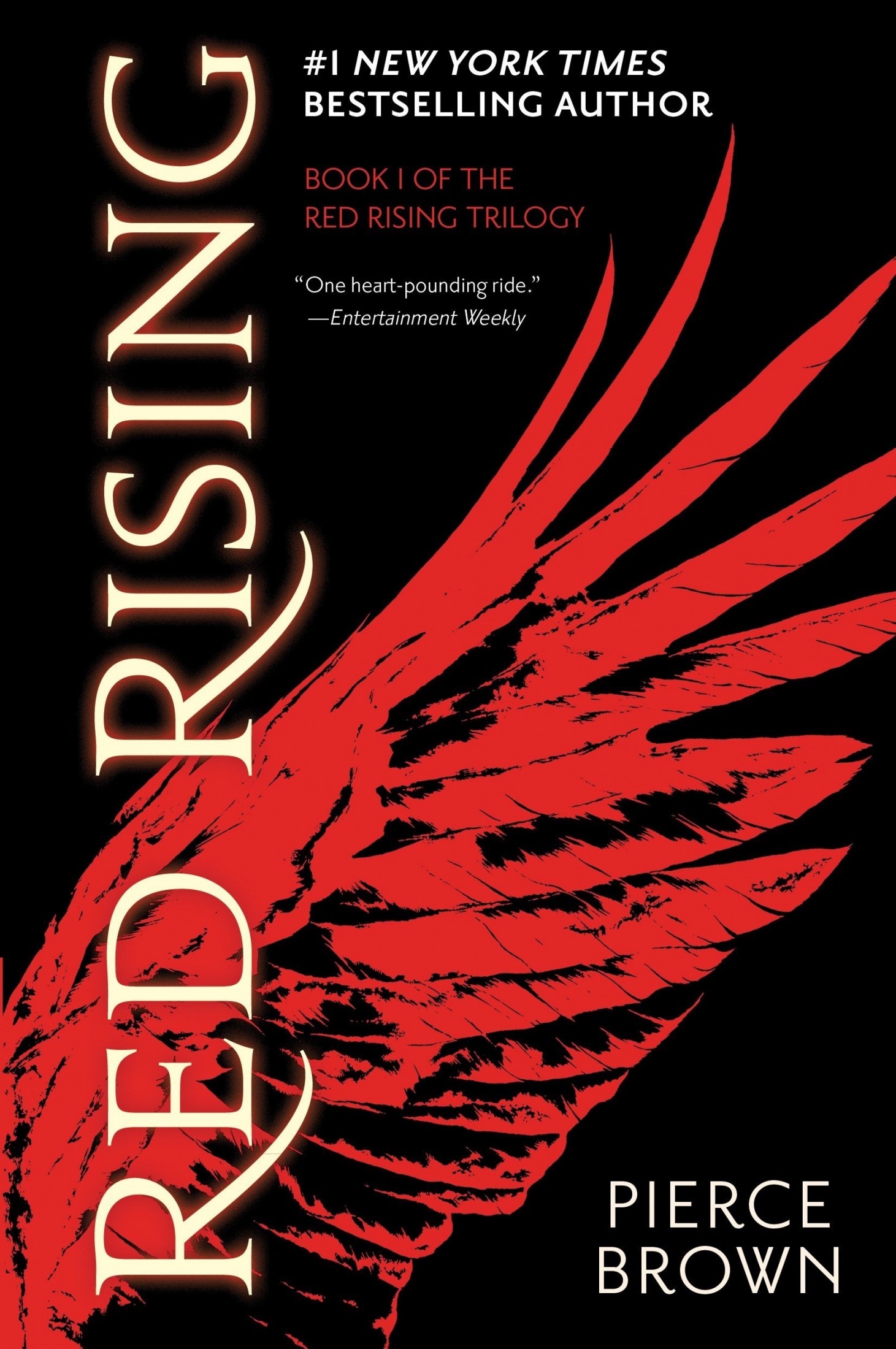
Red Rising, by , is the first book in the Red Rising Trilogy. It follows Darrow, a Red miner on Mars who discovers his entire caste has been enslaved, and joins a revolution by infiltrating the Gold ruling class.
I did not expect to like Red Rising.
It’s a pastiche of many popular books that came before it. Most directly, it’s ’s The Hunger Games, but on Mars. The Reds compete in their mines to win additional rations, and the children of the Golds are thrown into a violent game to win patronage. Being sorted into houses comes from ’s Harry Potter. The genetically stratified culture is borrowed from ’s Brave New World, and the color-coded castes are from , , and ’s Paranoia. The Golds’ belief that greatness is dragged down by lesser people who want to freeload is ’s Atlas Shrugged. The whole premise of an outsider destroying a corrupt empire from within by beating them at their own game is ’s The Player of Games. It even brings in game mechanics like leveling up to win Primus, straight out of the LitRPGs like ’s The Legendary Moonlight Sculptor that were just taking off in 2013.
Darrow is a Christ figure—like Severian in The Book of the New Sun, Father Duré in Hyperion, Edeard in The Void Trilogy, and Paul in Dune—but with a Greek twist. He dies for his people and is resurrected. Then he rises from the underworld to overthrow his masters, just as Cronus usurps his father, the sky-god Uranus. He even has a sickle.1
The strength of the book is its pacing. There is a new twist or cliffhanger every few pages. Darrow meets new characters, befriends them, and then watches them die in the span of a chapter. I kept turning pages to find out what happened next.
The book’s weakness is everything else. The mix of Greek and Roman history and mythology is almost coherent, but just when it feels like is about to make a deeper point or reinforce his themes, he muddles it. The Golds are modeled after Roman authoritarians while the good guys represent Athenian democracy! That’s why the Golds use Roman names and also Greek names and also they’re the Spartans… The shallowness stands out even more against ’s handling of myth and intertextuality in the Hyperion Cantos, which I read right before this.
And the pace, which is what kept me turning the pages, blunts the emotional impact. At one point Darrow discovers another Red disguised as a Gold, but one who is taking brutal revenge and endangering their mission. This enemy turned potential ally is supposed to be both a dark reflection of Darrow and a dilemma: how can Darrow kill this man who is more his brother than any of the Golds? Sounds like a strong emotional hook, right?! Too bad! We killed him in three pages. We won’t really think about that again. Moving on!
On top of all that, doesn’t trust the reader. At several points he has a character stop and explain to the reader what they should have picked up. The worst example is when the leader of the Golds on Mars tells the students that empires fall when they become decadent, and that this is why they devised the brutal Institute: to winnow those without the strength to rule the empire. So go murder each other while we drink and party on Mt. Olympus.
Red Rising reminded me of a lot of other books, some that clearly influenced it and others it might have influenced. The Institute is similar to the Battle School from ’s Ender’s Game, especially as a brutal environment to hone children into leaders; there is even a passing reference to Darrow as Wiggin. The Golds earn their right to rule through the Institute the same way Heinlein’s soldiers earn citizenship through service in Starship Troopers. The interfering Proctors are modeled on the Greek gods flying around the battlefield in ’s The Iliad and The Odyssey; Darrow’s soldiers emerging from corpses to take the gates are literally Trojan horses. The Golds’ lunar revolution and the way people talk slightly differently from modern English are like ’s The Moon Is a Harsh Mistress, and the broader revolution reminds me of ’s Metropolitan. Like Vandal in ’s Grand Melee, Darrow is given the choice of winning or bowing out but forwarding his cause. The faked execution mirrors how Endymion is saved and recruited in ’s Endymion, and Darrow’s trick of faking a fire to reveal the opponent’s banner is borrowed from Sherlock Holmes in ’s A Scandal in Bohemia. Iron Golds have cheek scars like those in ’s The Final Architecture, based on dueling scars from 19th century Germany and Austria, and there are throwaway references to Osgiliath from ’s The Lord of the Rings. Mickey changing Darrow to pass as a gold is right out of Gattaca. Mickey himself reminded me of Ximenyr from ’s The Hydrogen Sonata.
There are so many reasons I shouldn’t recommend this book, but in the end it was a fun read. Will I continue on to Golden Son and Morning Star? It feels like might have used up all his tricks already, but if I do, I’ll write about them.
-
Although so far he hasn’t castrated anyone with it. ↩