Monday Begins on Saturday
Review
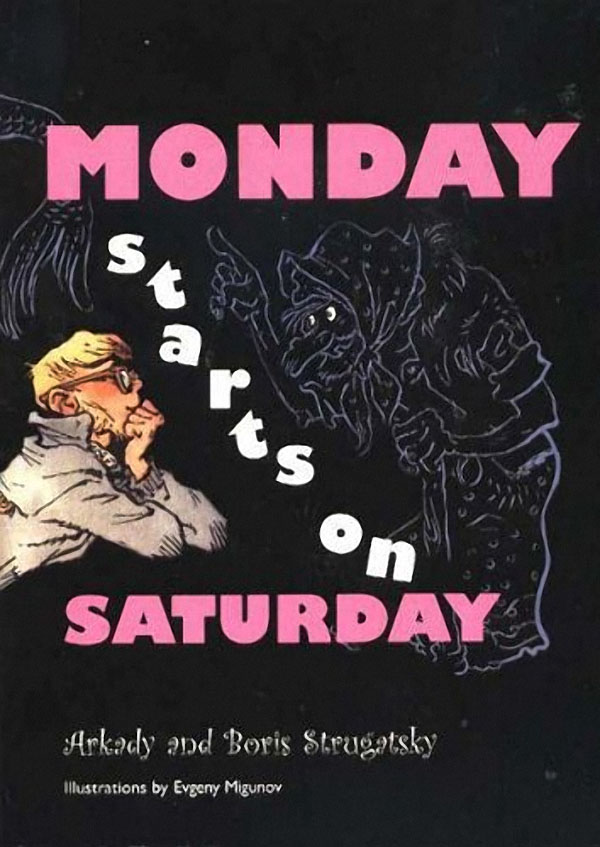
Monday Begins on Saturday, by brothers and , is a Soviet sci-fi novel about scientist-magicians working at the National Institute for the Technology of Witchcraft and Thaumaturgy (NITWITT), where they study fairy-tale creatures and magic items.
Monday Begins on Saturday is like a light-hearted version of ’s There Is No Antimemetics Division, or ’s The Laundry Files and A Colder War. It follows scientists at NITWITT as they study Maxwell’s demons, Dracula, magic wands, and dragons while dealing with Soviet bureaucracy. On paper this should be exactly my kind of story! I love the “bureaucrats dealing with the supernatural” genre, and I’ve worked at LBL and CERN, the kind of giant research institutes this book satirizes. But while the ideas and characters are fun, there isn’t really a story tying it all together. said they had the concept for a long time but struggled “to think of a story or a plot for the adventure”.1 I don’t think they ever quite found one.
Monday Begins on Saturday is split into three loosely connected vignettes that wander around somewhat aimlessly. The third, where they solve the mystery of A-Janus/S-Janus, who is one person in two bodies, was my favorite because it comes closest to a classic “slowly unveiled mystery” plot. The other two are more slice-of-life around the institute and don’t have a payoff like the third. The first vignette, which introduces the whole institute and concept, has the least structure, which causes the book to stumble right from the start.
Monday Begins on Saturday shares some themes with and ’s Roadside Picnic. Both are interested in happiness: NITWITT’s mission is to discover and perfect human happiness, and in Roadside Picnic Red’s final wish is for “HAPPINESS, FREE, FOR EVERYONE, AND LET NO ONE BE FORGOTTEN!” They also both deal with humans interacting with human-like simulacra. In Saturday, the doubles are helpful, collecting your paycheck or going to parties so you can work more, while in Picnic the artificial Arthur and Dina feel much more sinister. The difference in tone—Monday Begins on Saturday is optimistic in a way Roadside Picnic is not—probably reflects when they were written: Saturday came out during the liberalizing Khrushchev thaw, while Picnic was written during the stagnation of the ’70s.
Monday Begins on Saturday also reminded me of several other works. The “institute that contains anomalous items” is like the SCP Foundation from There Is No Antimemetics Division. NITWITT has an infinite library like ’s The Library of Babel. The protagonist traveling into a fictitious world is like Alice in ’s Alice’s Adventures in Wonderland. And A-Janus/S-Janus moving backwards through time reminded me of Moneta in ’s Hyperion.
Despite its faults, I love and ’s characters and dialogue. There’s a real plainness to how their characters talk that makes them feel alive, almost like . I have a bunch more of their books on my list, and I’m looking forward to them because I know they can write masterpieces even if they didn’t manage it this time.
Up next is This Is How You Lose the Time War for the book club, and then I think I’ll return to the Hyperion Cantos with The Fall of Hyperion.
-
We came up with the idea of a story about wizards, witches, sorcerers, and magicians a long time ago, at the end of the 1950s. To begin with we had no idea of what might happen in it; all we knew was that the heroes would be characters from the fairy tales, legends, myths, and ghost stories of all cultures and times. And that their adventures would take place against the backdrop of a research institute with all its foibles, well known to one of us from his own personal experience, and to the other from the many stories recounted to him by his academic friends. We spent a long time gathering together jokes and nicknames and amusing characteristics for our future characters, and wrote them all down on separate scraps of paper (which, as always happens, were later lost). But no real advance took place; we were never able to think of a story or a plot for the adventure.
From Strugatsky, Boris. “Afterword” Monday Begins on Saturday. ↩