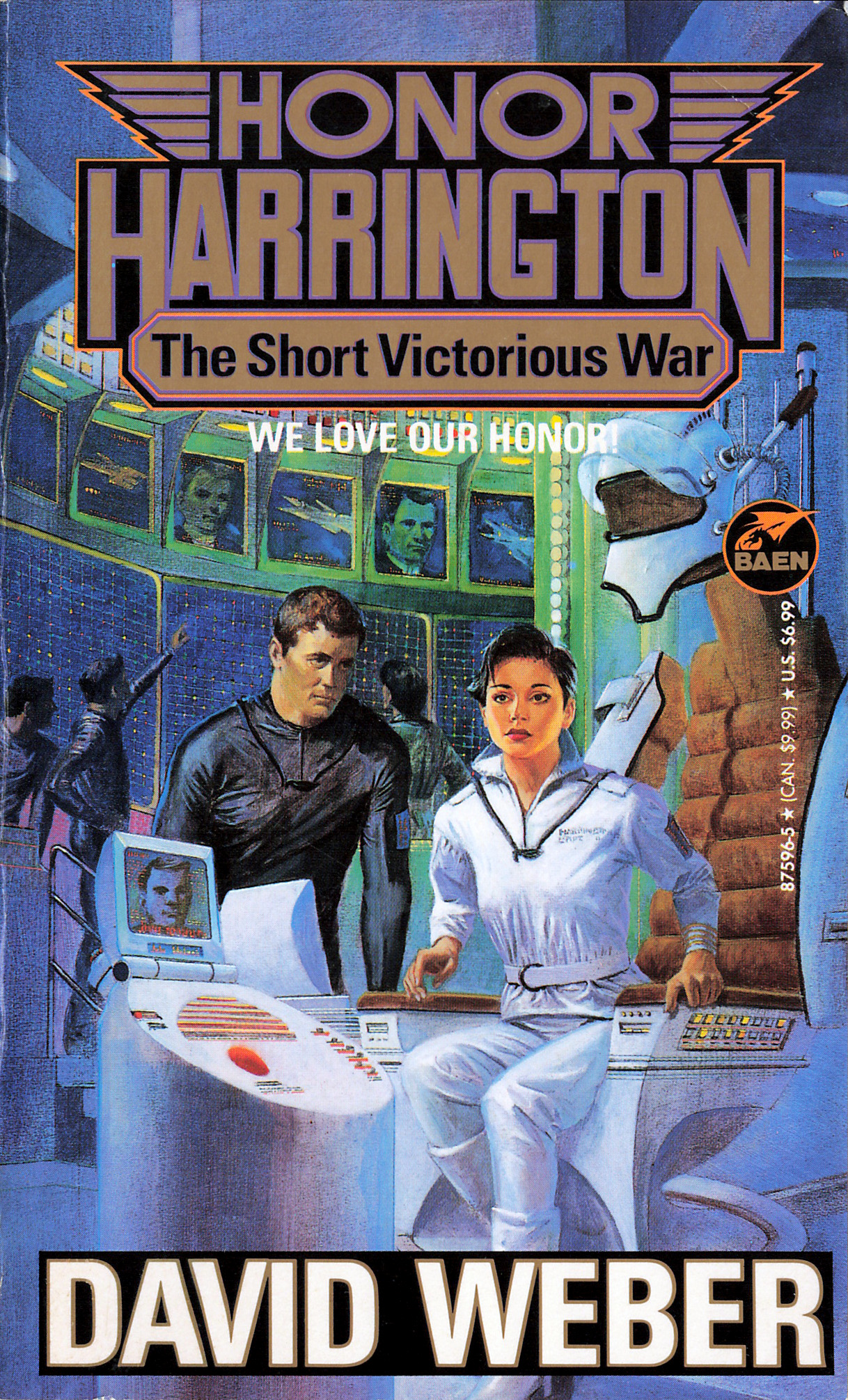
The Short Victorious War, by David Weber, is the third book in the Honor Harrington series. Harrington takes command of the battlecruiser Nike as the People’s Republic of Haven makes its move and a revolution brews in Nouveau Paris.
The Short Victorious War is the culmination of On Basilisk Station and The Honor of the Queen: the war with Haven finally kicks off with Harrington right in the middle, of course. David Weber brings in multiple storylines that expand the universe without it feeling like a sudden change, and when the shooting starts we get our first dreadnought and superdreadnought battles. These improvements over the first two books make The Short Victorious War the best one so far. It feels like it’s operating on a completely new scale. But that larger scale makes one thing clear: Weber has no sense of subtlety.
Sometimes this is a strength. Pavel Young—Harrington’s attempted rapist—is unrepentant. He’s done it before, he’ll do it again, he has no remorse. While Harrington grows more attractive with age, Young is getting fat and slovenly. He’s a cartoon villain, and after Tchaikovsky’s hand-wringing in Lords of Uncreation over whether the genocidal Originators really deserved to be fought, a cartoon villain is fine. Not every book needs to wrestle with who the real bad guys are.
The Short Victorious War reminded me of a few other books. Haven’s Mental Hygiene Police, who monitor citizens for ideological deviance, are straight out of Orwell’s 1984. The revolution against hereditary rulers is similar to Williams’sMetropolitan, though Weber is so far less interested in what comes after. The cover-ups and backroom dealings in Nouveau Paris have a Clancy feel, especially the assassination by shoulder-launched missile. And the “megs” of paperwork date the book the same way pocket computers but no smartphones date Benford’sEater.
Weber’s lack of subtlety works in The Short Victorious War because it’s a big, over-the-top war story. But I’m worried about Field of Dishonor. It looks like it’s going to shift to more personal and political conflicts, and that’s where the lack of subtlety might start to hurt.
Some of these, Weber has said, were intentional, if heavy-handed, red herrings:
It would, however, be a mistake to read too much parallelism into the “Honorverse.” There are obvious resonances, but although there are some distinct similarities between the People’s Republic of Haven and Revolutionary France (and especially between the Jacobins and the Havenite Committee of Public Safety under one Rob S. Pierre), France was never the actual template upon which the People’s Republic had been imposed. Mind you, I did my very best to fling out as many red herrings as possible to convince readers that it was, because I didn’t want them to see where I really meant to go with the political developments in the series. By making Haven look like Revolutionary France (hence the French names, calling the capital “Nouveau Paris,” and a few other minor things of that nature), I conditioned readers who’d picked up on it and who knew their history to expect me to eventually produce the Havenite equivalent of Emperor Napoleon, when in fact I had absolutely no intention of doing anything of the sort.
—Weber, David. "FAQ: Honorverse" David Weber. Retrieved March 28, 2026.↩