The Rise of Endymion
Review
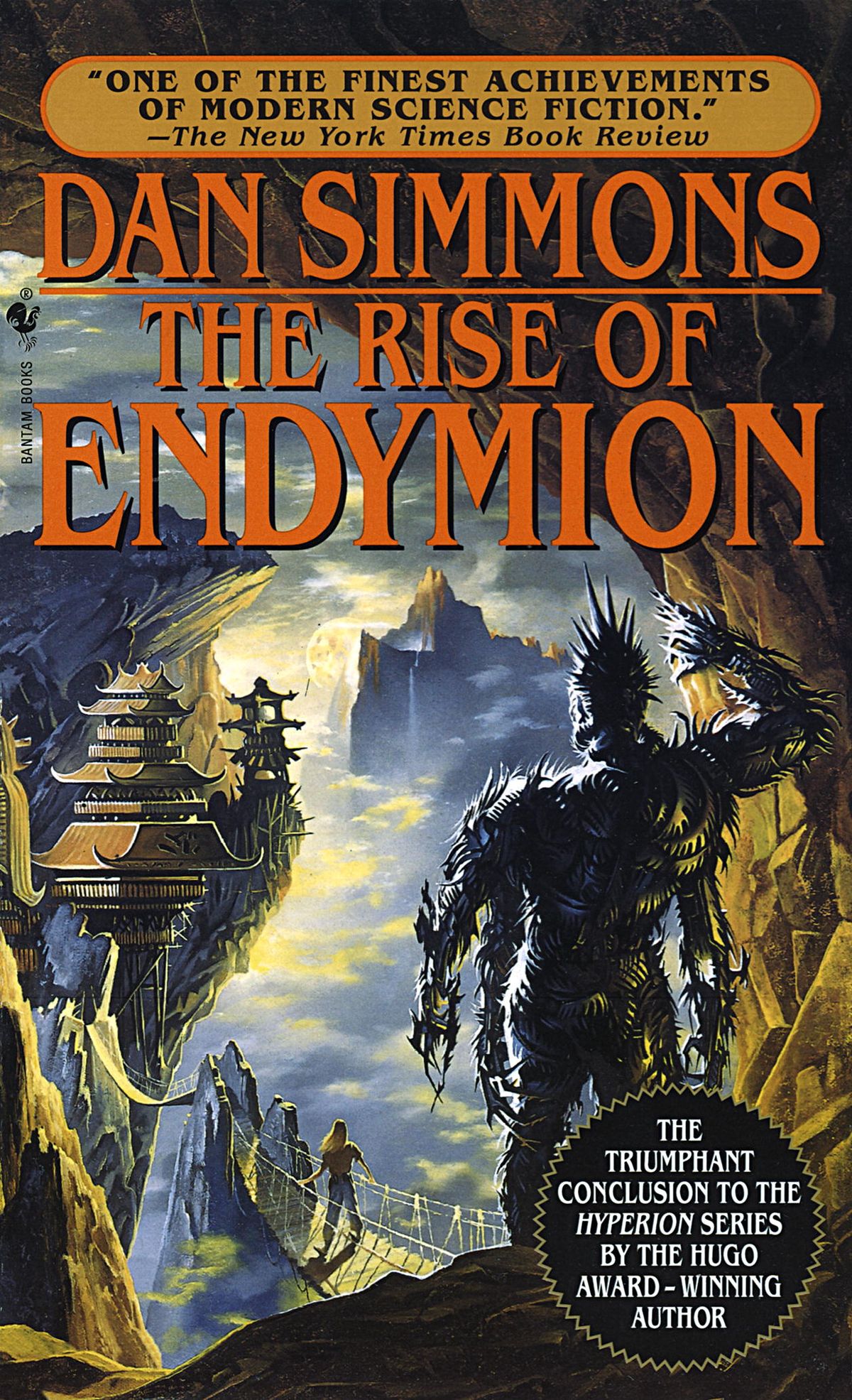
The Rise of Endymion, by , is the fourth and final book in the Hyperion Cantos. It concludes the journey of Aenea and Raul as they race to unlock the secret of the Void Which Binds before the Pax can silence them. It resolves the mysteries of the Shrike and the TechnoCore while arguing that the Church’s immortality is a trap: to truly live, humanity must be willing to die.
Themes
The Rise of Endymion breaks from the past three books in the the Hyperion Cantos in that it is not named and themed after one of ’s works. Instead, it mirrors ’s life. Aenea is a stand-in who, like the poet, knows her time is short and rushes to complete her life’s work of helping people understand the world and become empathetic. Her philosophy and interaction with the Void Which Binds embody his concept of the Chameleon Poet, allowing everyone to feel what others feel.
Aenea is also a Christ-like figure, a point drives home when he has her explain that Christ was the first human able to touch the Void. Like the Christian Eucharist, Aenea’s disciples drink her blood to achieve communion. But makes the theological subtext text: the blood contains viral RNA that rewrites their DNA, granting them the ability to touch the Void and literally share the perspective of others.
This messianic arc is reminiscent of Severian in ’s The Book of the New Sun and especially The Urth of the New Sun, another torture-linked savior who must bring destruction to save the world. And it is the inverse of ’s A Canticle for Leibowitz; instead of the church being the ark of humanity to protect it from the deluge, the Pax is the stagnation the must be wiped out by the flood.
Story
I liked this book about the same as Endymion, but the pacing was worse. The first third jumps back and forth from cliffhanger to cliffhanger, while the middle third on T’ien Shan drags as it spends 300 pages in one place, following Aenea as she preaches to her disciples. The book is saved by a climax that wraps up the series and explains more mysteries from the first three books, just as The Fall of Hyperion does for Hyperion.
I still didn’t like Raul or Aenea, although their relationship was a little better this time around. But the supporting characters—A. Bettik, Federico de Soya, Kassad—are great, even if Bettik gets sidelined for most of the book only to show up at the end as the observer for the other powers of the Void.
Literary References
As in his previous works, fills The Rise of Endymion with references to science fiction and popular culture. He directly compares Aenea and Raul to Scout and Boo Radley from ’s To Kill a Mockingbird. One of the crops of Mars is “Bradberries” in honor of and his The Martian Chronicles. The triune marriages of the Amoiete Spectrum Helix are like the non-traditional marriages from ’s The Moon Is a Harsh Mistress; their windwagons remind me of the wind-powered cable cars in ’s Look to Windward. The linear city is like the girdle city in The Hydrogen Sonata. When Raul kayaked through the canals of Lusus surrounded by massive hive buildings, it reminded me of ’s City on Fire. Exploring the next step in human evolution is similar to ’s Childhood’s End. The need to splinter humanity and scatter them across the universe to prevent stagnation is like the Golden Path from ’s Dune, Dune Messiah, and Children of Dune, with Aenea playing the role of Leto II. The Void, as an alternate dimension that allows instant travel and reflects the minds of people in the universe, is similar to Unspace in ’s The Final Architecture. The biological Ousters fighting the technology-centric Core is like the conflict in and ’s This Is How You Lose the Time War.
The Author
has been a mystery to me while reading the Hyperion Cantos. I know he’s now known for his far-right views, and so I’ve looked for the seeds of them in his work.
At first glance, they are hard to find. The books feature a multicultural cast, there are gay characters in the background, and the thesis of The Rise of Endymion is that diversity is our strength. Fedmahn Kassad, a Palestinian, is a hero in the series.
But on closer inspection, the seeds are there. There’s an uncomfortable obsession with the sexuality of young girls. There’s his throwaway comment about “Welfare Queens” in this book. And even with Kassad, there is a hint that he has distinguished himself as a “good Muslim” by accepting the civilizing influence of the Hegemony and replacing his religion with the secular New Bushido code, in contrast to the Sunni and Shi’ite Muslims of Qom-Riyadh who go back to slaughtering each other as soon as the empire is distracted.
I don’t think I will read any more of ’s work. I hear Ilium and Olympos take the anti-Muslim stance to another level, and that Flashback is a right-wing screed against a barely disguised Obama. In some ways it is easier to support an artist who is a horrible person—like or —after they’re dead. I won’t read because supporting her gives her more money and power to attack my trans friends, and I feel the same about .