The Weaving of Code
View as Markdown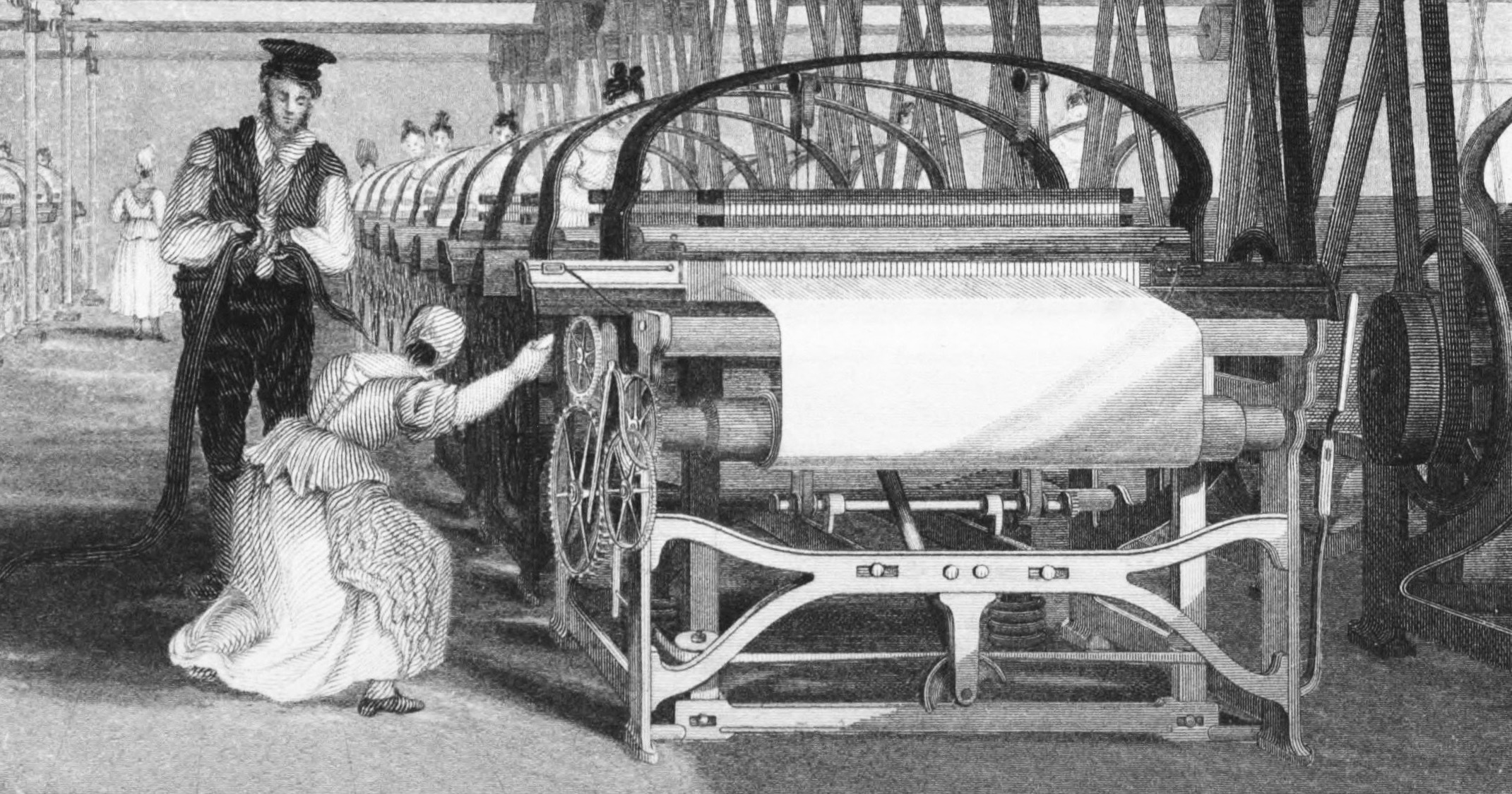
I think most software engineers are starting to wonder about their future and that of their field with the rise of LLM coding. I certainly am. We prided ourselves on our technical ability, but in the past year machines have completely surpassed us. What are we good for if not that?
Prony
In 1793, Gaspard de Prony was tasked with computing books full of logarithms and trigonometric functions for the French national land survey. He divided the labor into three tiers:
-
Mathematicians, including Legendre, who did the high-level algorithm work.
-
Planners, who turned the algorithms into worksheets and checked the computers’ work.
-
Computers, some of them former hairdressers, who did the tedious calculations.
If you squint at it, that’s almost the same way we structure software companies, with staff engineers looking at large-scale direction, senior engineers figuring out how to implement the directive, and juniors churning out the raw code. The difference, of course, is Prony’s hairdressers were never expected to become planners or mathematicians, whereas a junior was expected to learn and become a senior. But that pipeline is breaking. Lately I keep having some version of this conversation:
Me: Are people still hiring junior engineers? We just laid a bunch off.
Friend: I know… Where are the next senior engineers supposed to come from if nobody trains them?
Me: Everyone seems to think that’s someone else’s problem. But… did they need another generation of apprentices once the Jacquard loom was invented?
Babbage
In 1832, Charles Babbage published On the Economy of Machinery and Manufactures, which codified the division of labor Prony had used for his survey into what is now known as the “Babbage principle”. He explained that highly skilled—and hence highly paid!—workers spend some of their time doing tasks below their skill level, and that it is better to hire those tasks out to lower-skill workers. This economic force splits jobs into tiers by skill.1
Babbage had already looked at the bottom tier of Prony’s skill division and thought that adding and subtracting numbers was a good task to automate. He failed. Human computers survived for over a century, until electronic computers replaced them in the post-war era. Some of them weren’t replaced, though. They moved up. Six former computers—McNulty, Snyder, Wescoff, Lichterman, Jennings, and Bilas—were recruited to program ENIAC, one of the first electronic computers.
Look closer, though, and the junior–senior–staff leveling system doesn’t fit Prony’s. It leaves out the old bottom rung. Computers still exist; they’re made of silicon now. Junior and senior engineers are really both planners, split into two jobs by the Babbage principle. Now LLMs are moving up another step on the ladder, taking the junior half. Human computers lasted about 350 years, junior engineers around 70. I’m not sure how long senior and staff engineers will hold on.
Lovelace
Babbage later designed a general-purpose machine, the Analytical Engine, using punched cards inspired by the Jacquard loom to tell it what to do. Those same cards stuck around through ENIAC and other early electronic computers. In 1843, Ada Lovelace wrote in her notes on the Engine:
We may say most aptly that the Analytical Engine weaves algebraical patterns just as the Jacquard-loom weaves flowers and leaves.
But, looking at the division of skill, she too drew the line low:
The Analytical Engine has no pretensions whatever to originate any thing. It can do whatever we know how to order it to perform. It can follow analysis; but it has no power of anticipating any analytical relations or truths. Its province is to assist us in making available what we are already acquainted with.
That’s what finally broke. In 2022, AI could fill in the next line of code. By 2025, coding agents could write the entire thing. Computers had suddenly moved up and taken the junior engineer’s job. Then in 2026, they made the next leap.
In January, Erdős problem #728 was solved by an AI, with little human intervention. In July, the Dinitz–Garg–Goemans conjecture was disproved by asking an AI to “do a breakthrough”. In September, AI solved Navier–Stokes existence and smoothness, one of the Millennium Problems. In November, an AI-assisted human proved the Riemann Hypothesis, which had stood for 167 years and was considered the holy grail by many mathematicians.
The last of Prony’s tiers fell to automation.
The End?
It was Antoine Tilloy’s The short age of dragon riders that got me thinking about all this again. His conclusion is similar to mine, that some people will move up a tier and “ride the dragon” that is AI, until they don’t:
I suspect the value of good dragon riders will increase exponentially until it collapses dramatically. At some point it will not be possible to raise the bar, stay above the wave, and it is plausible that nothing biological will be able to give valuable insights to the silicon. The dragon will know what to do. But we live now, not in three years.
The machines have already moved up, just not everywhere at once. The frontier is jagged. Some math theorems fall with “do a breakthrough”; others still require human direction. At work I’m still in the saddle, riding the dragon. I don’t write code, but I decide what my agents will work on. I led a team of 8 data scientists for 2 years, and this feels a lot more like that manager role than my IC role. Maybe I’ll get one more warning as the seniors get laid off, leaving only us staff engineers. Or maybe not.
For a while I thought I could make a career of sliding down the dragon’s tail. Tech used to work like that: build something at a cutting-edge company, then sell it down the line to less and less sophisticated companies as they realized they needed it. But the bitter lesson came for that too. Once a company can just say “automate away my workforce, do a breakthrough”, it doesn’t need my expertise.
Machines first wove flowers and leaves, then algebraical patterns, and now code. Soon they will move up again, but we live now, not in three years.
-
We’ve already seen this splitting in Data Science/Machine Learning along the “engineeriness” dimension, as I documented in my articles The Data Science Split: From Unicorns to Teams and The Data Science Spectrum: From Analyst to Machine Learning. ↩