Caltrain Visual Schedule: 2026
View as MarkdownIn 2017, I created some visual schedules for Caltrain, just to have some fun tweaking plots. A few months later, I updated them when Caltrain changed its schedule to accommodate the upcoming electrification program. Now, 9 years later, the electrification work is complete, so I updated the plots1 to see what changed. You can find the code here.
Weekday
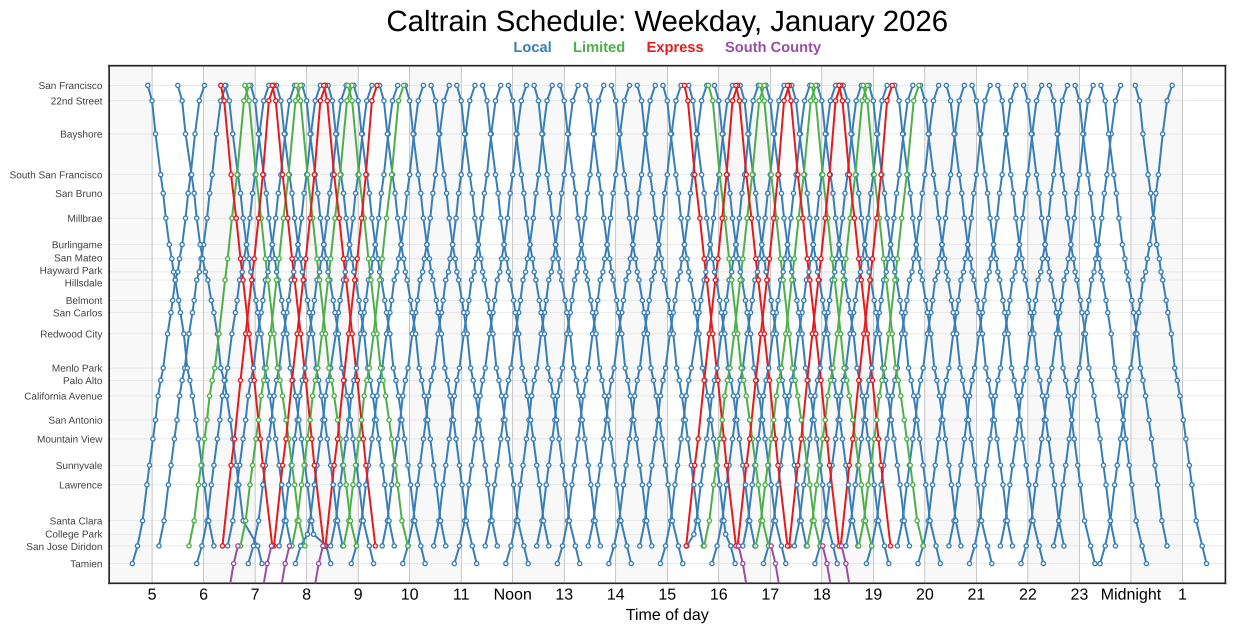
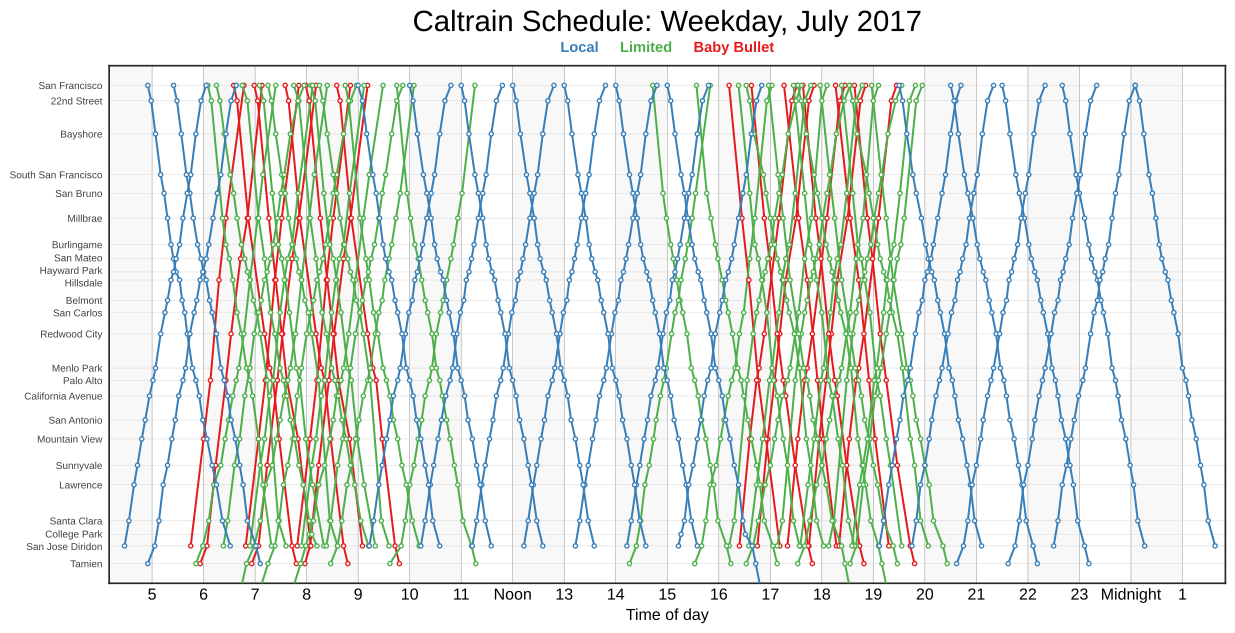
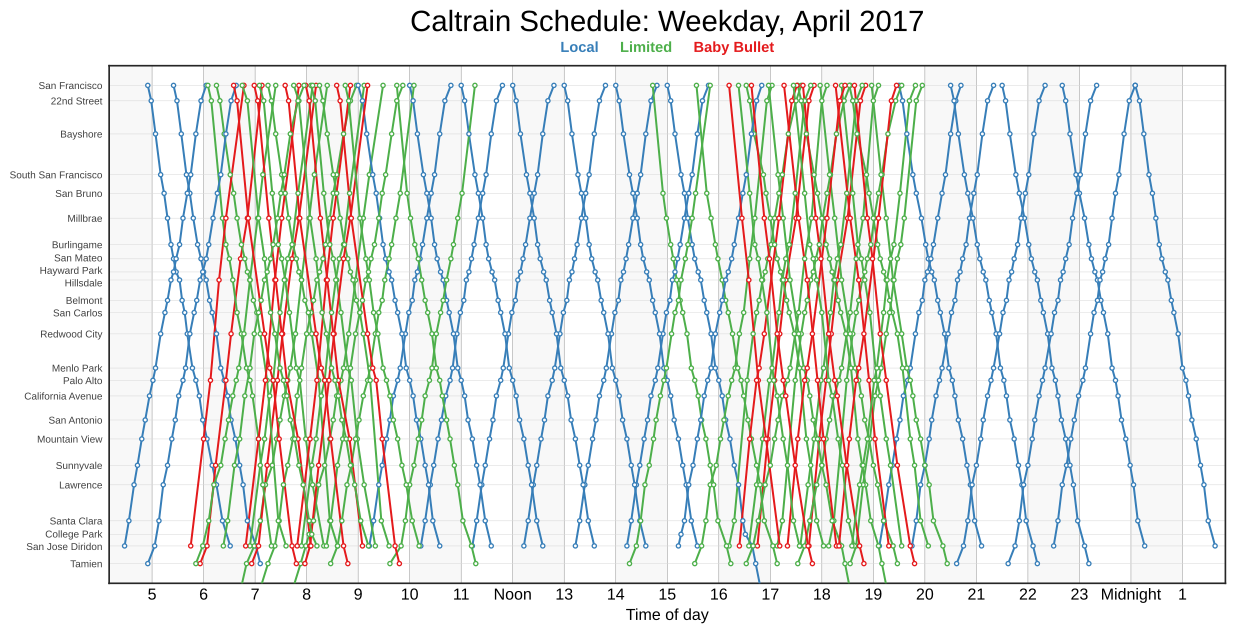
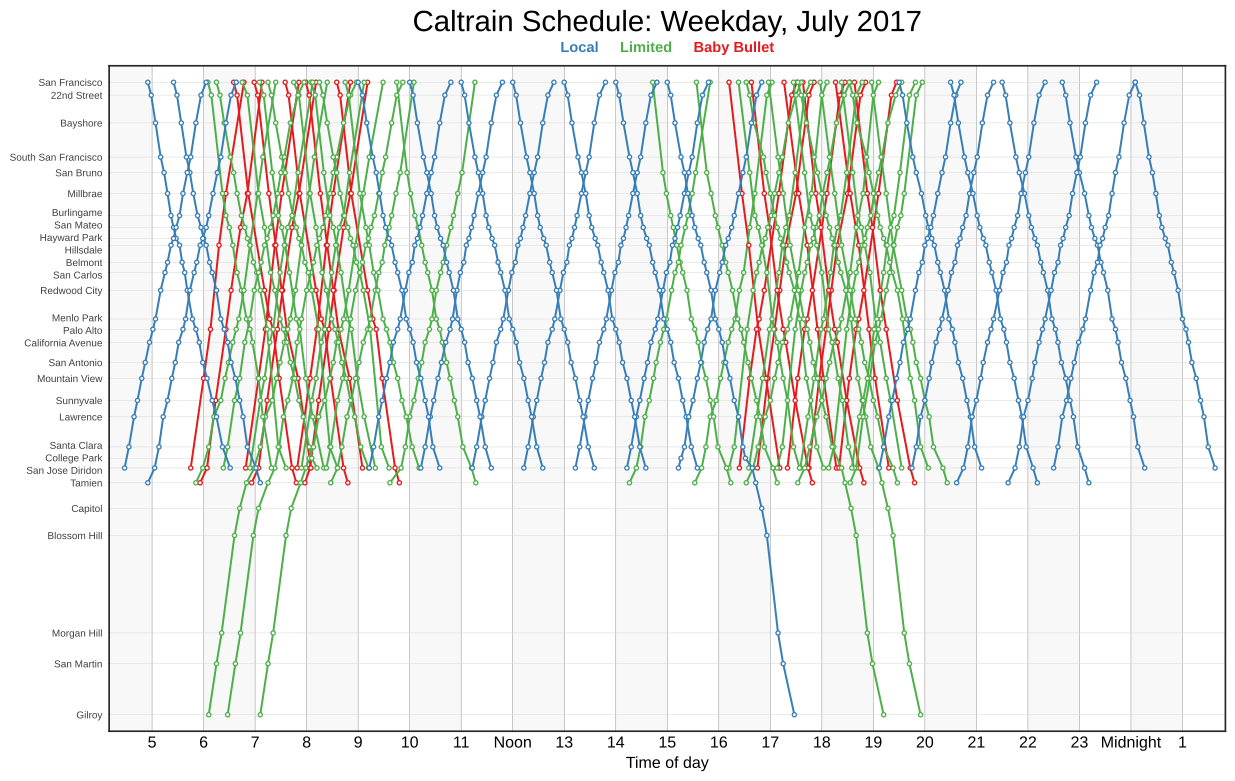
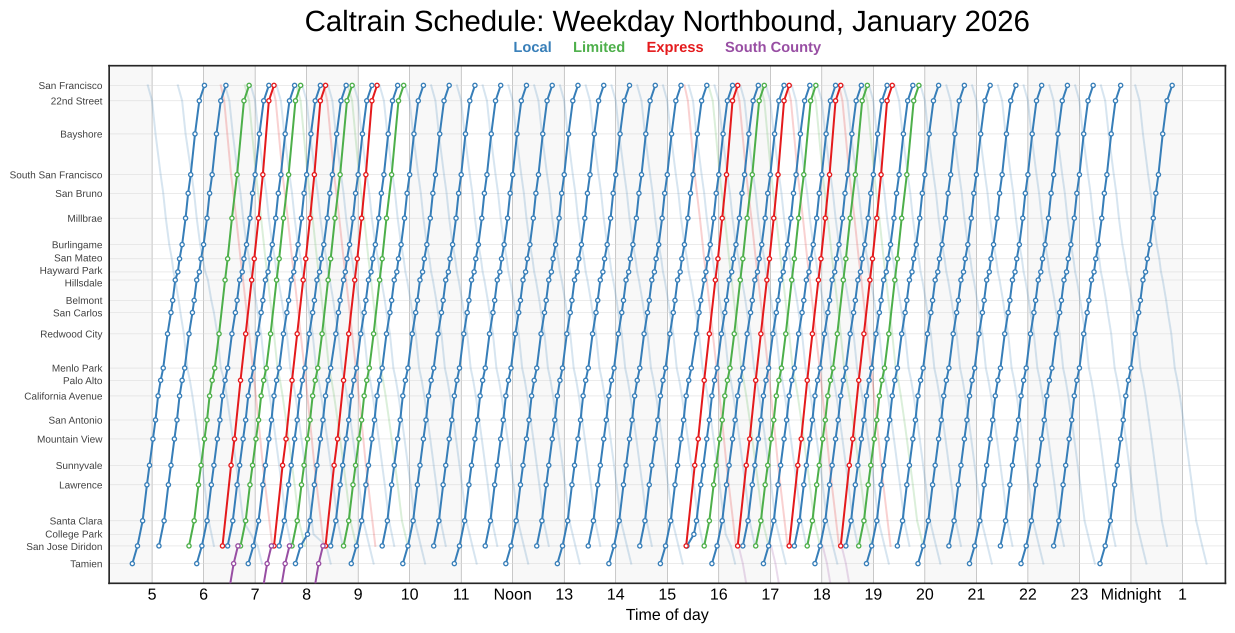
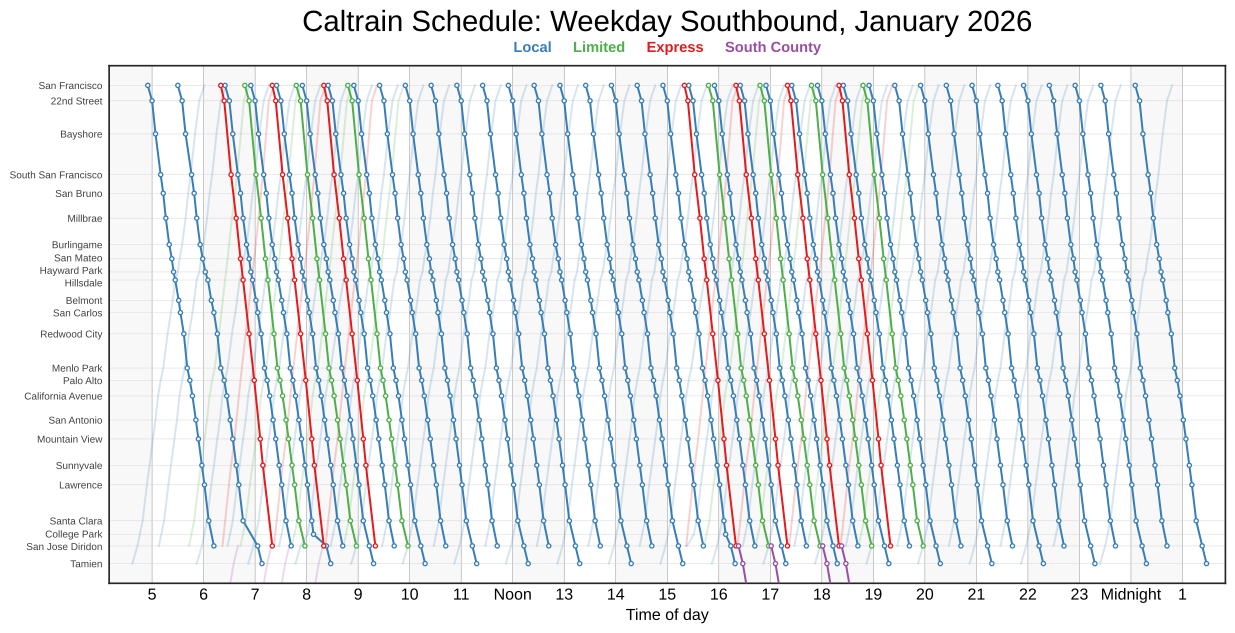
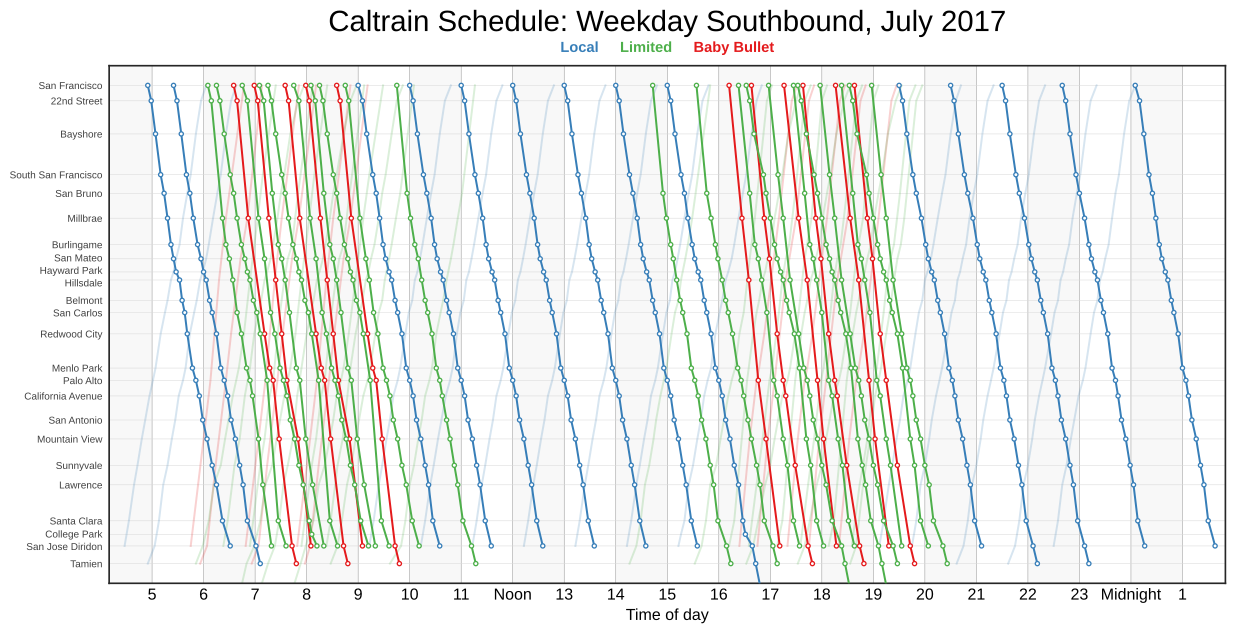
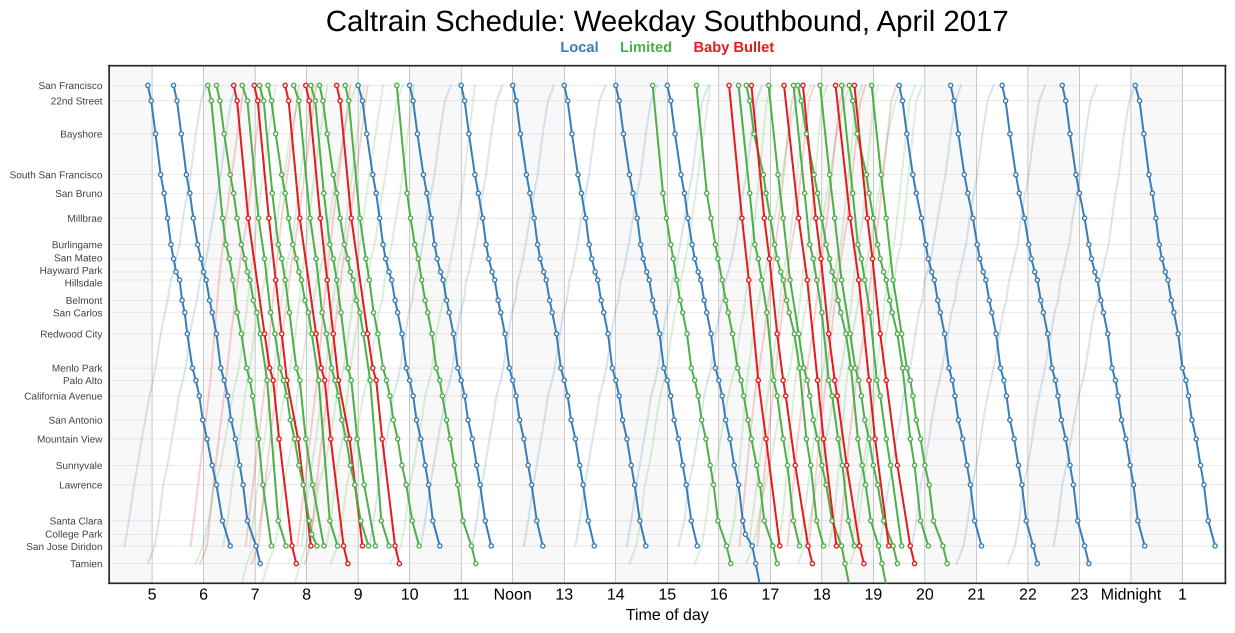
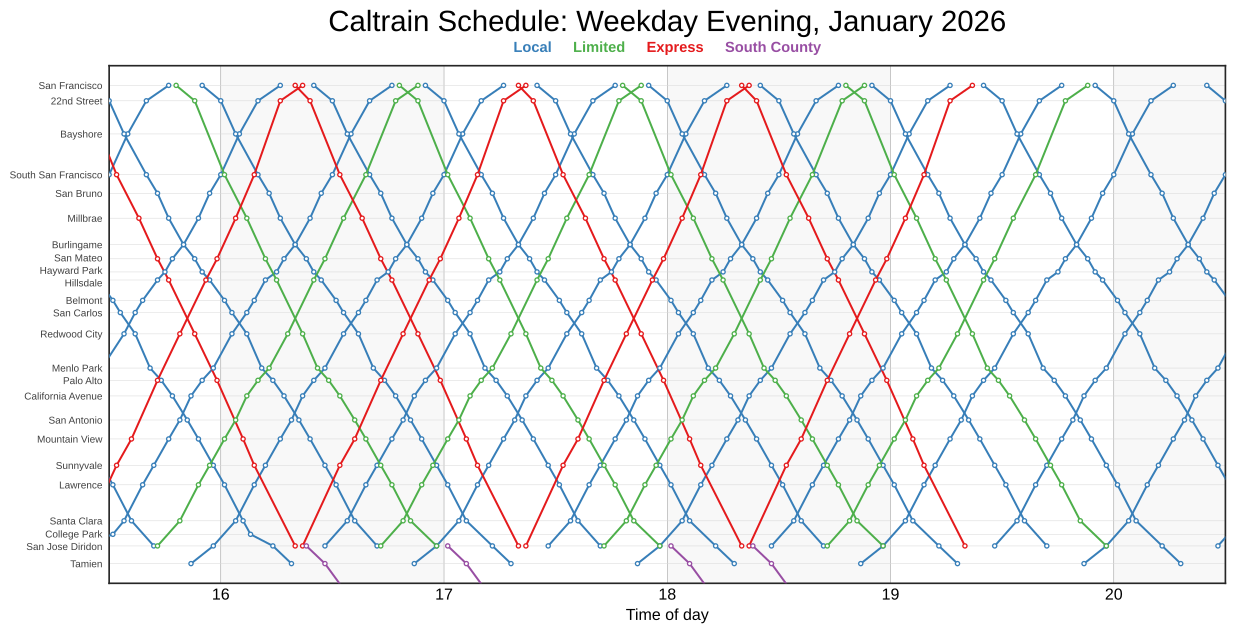
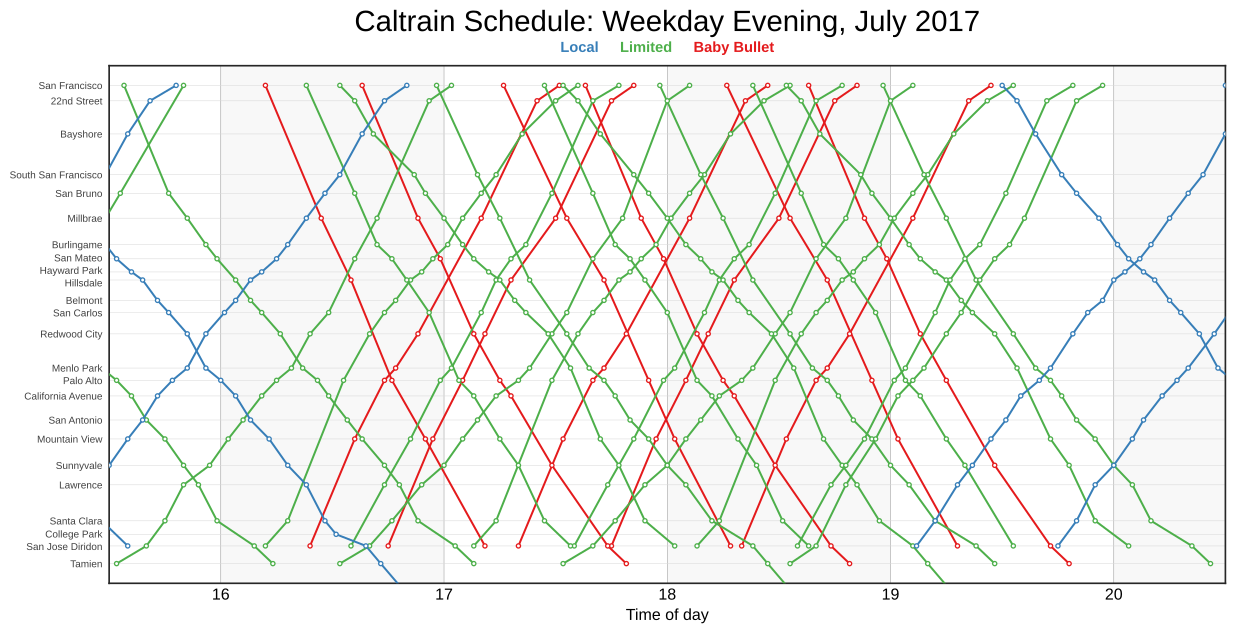
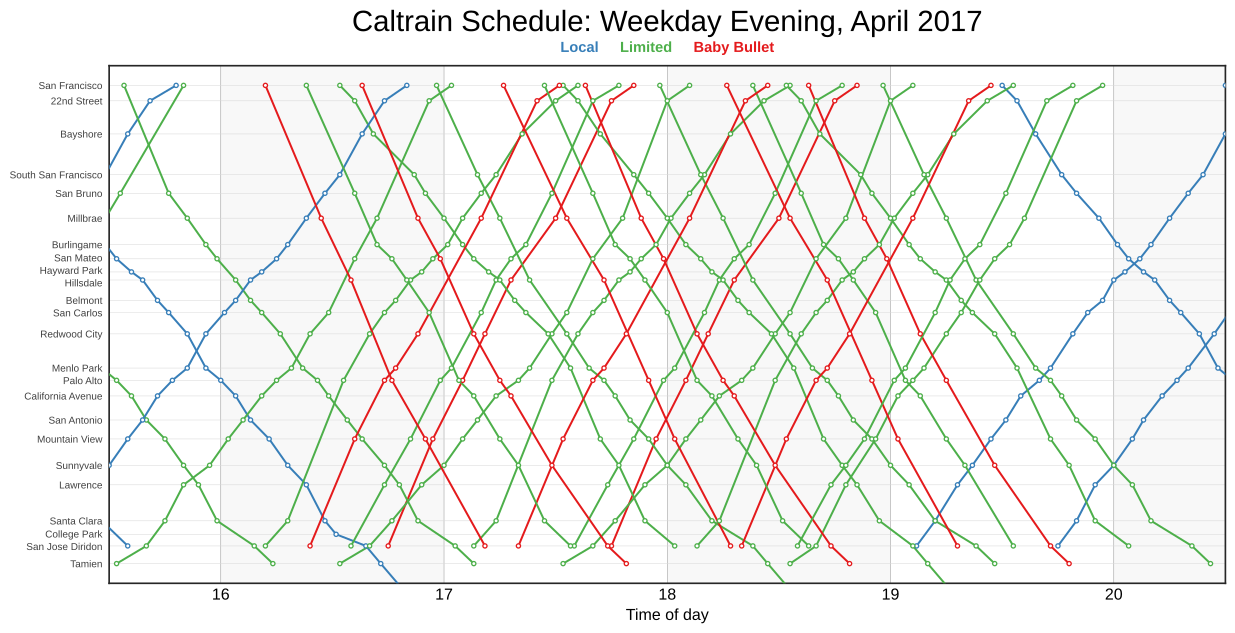
The first thing you notice when comparing the new schedule (top) to the old schedule (bottom) is: there are a lot more trains! Two local trains an hour for almost the entire day, compared to just one earlier.
Second, there is a new type of train: the “South County”, which travels exclusively between Gilroy and Diridon. This is a consequence of the electrification of the northern half of the line. The Gilroy to Diridon leg uses the old diesel fleet, while Tamien to San Francisco uses the new electric trains; they overlap on the Tamien to Diridon section.
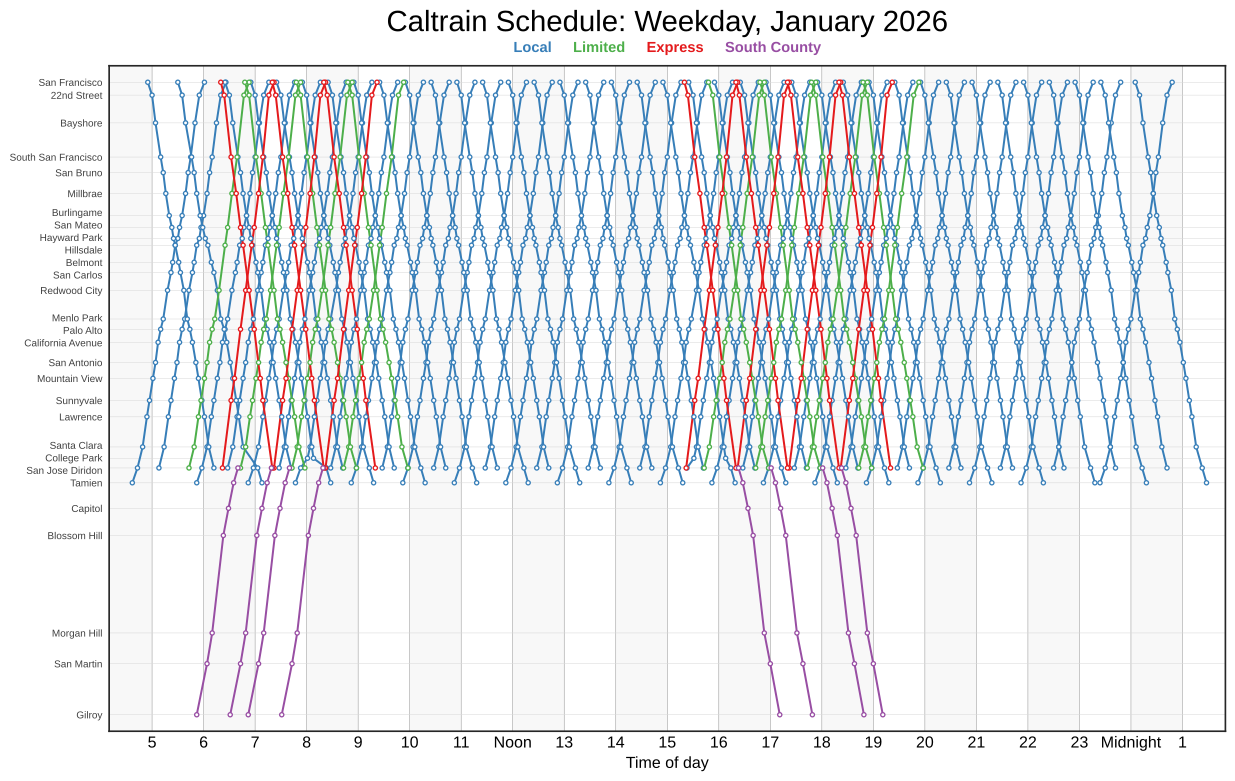
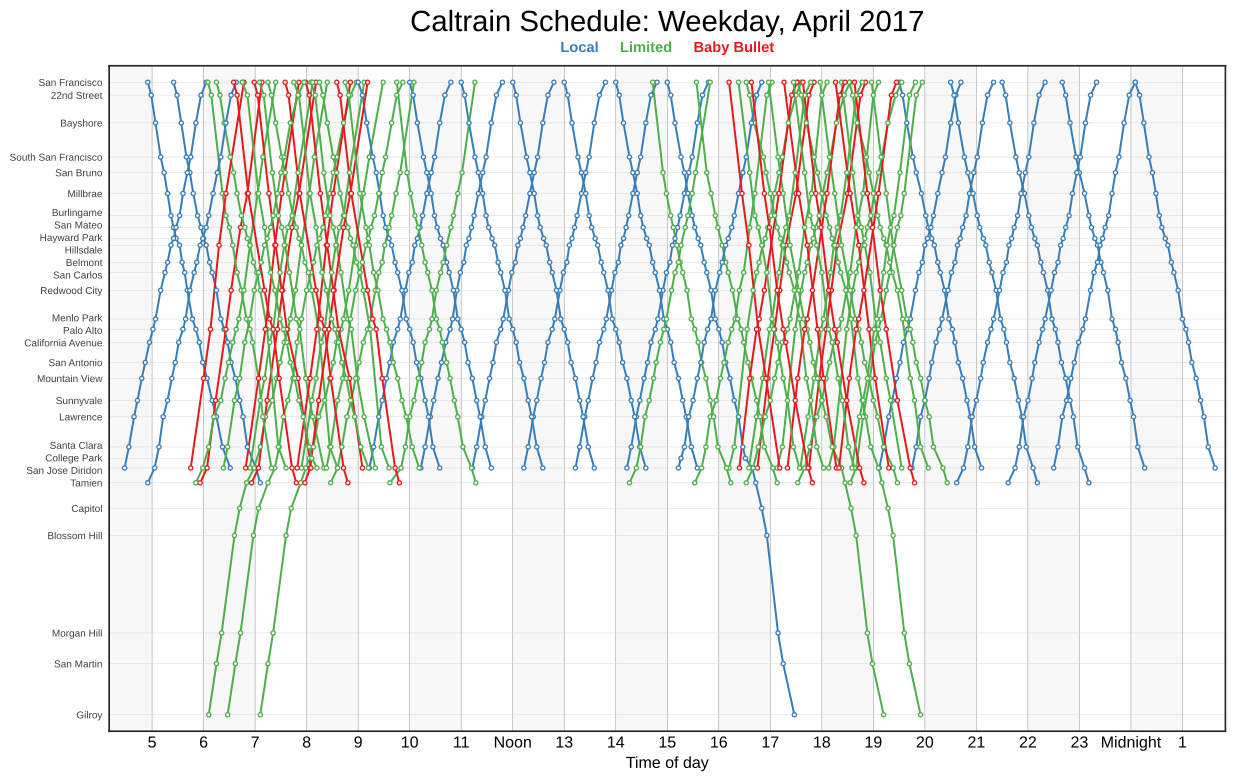
But beyond those two facts, it’s tough to see details unless we focus on a smaller portion.
Morning Commute
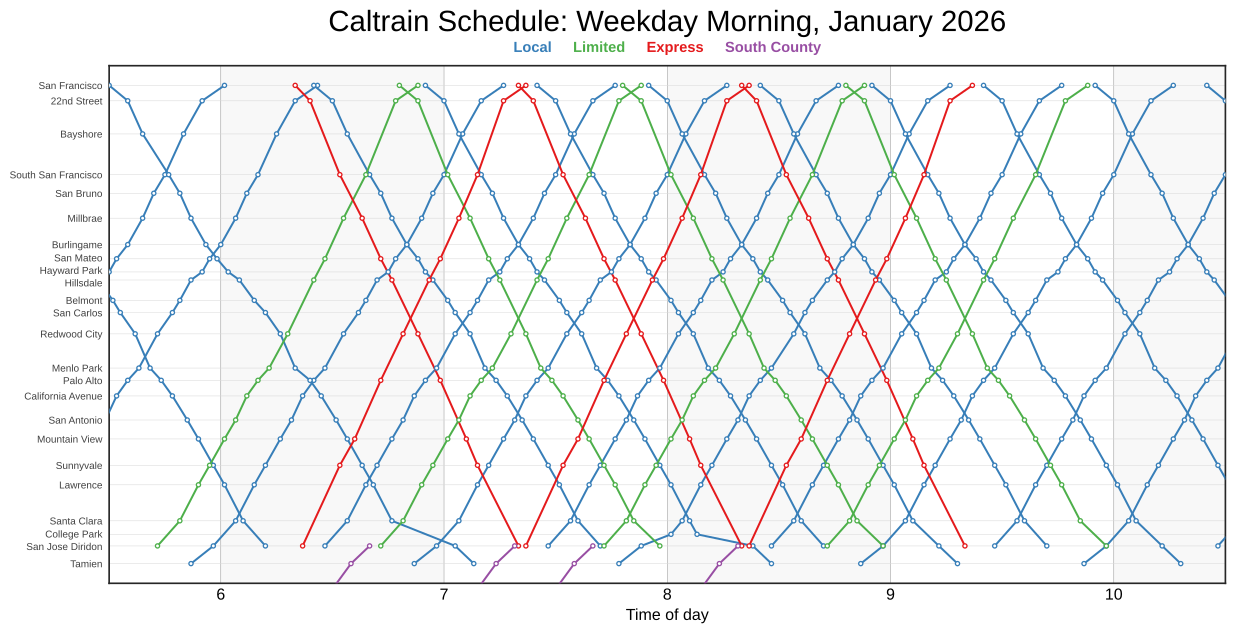
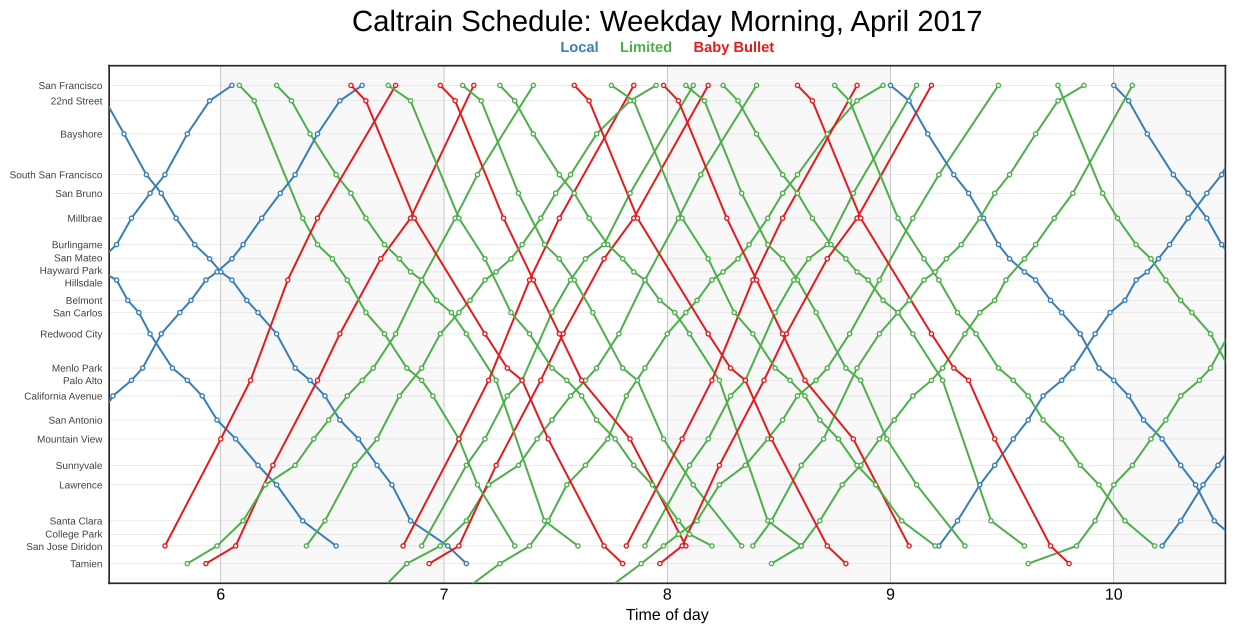
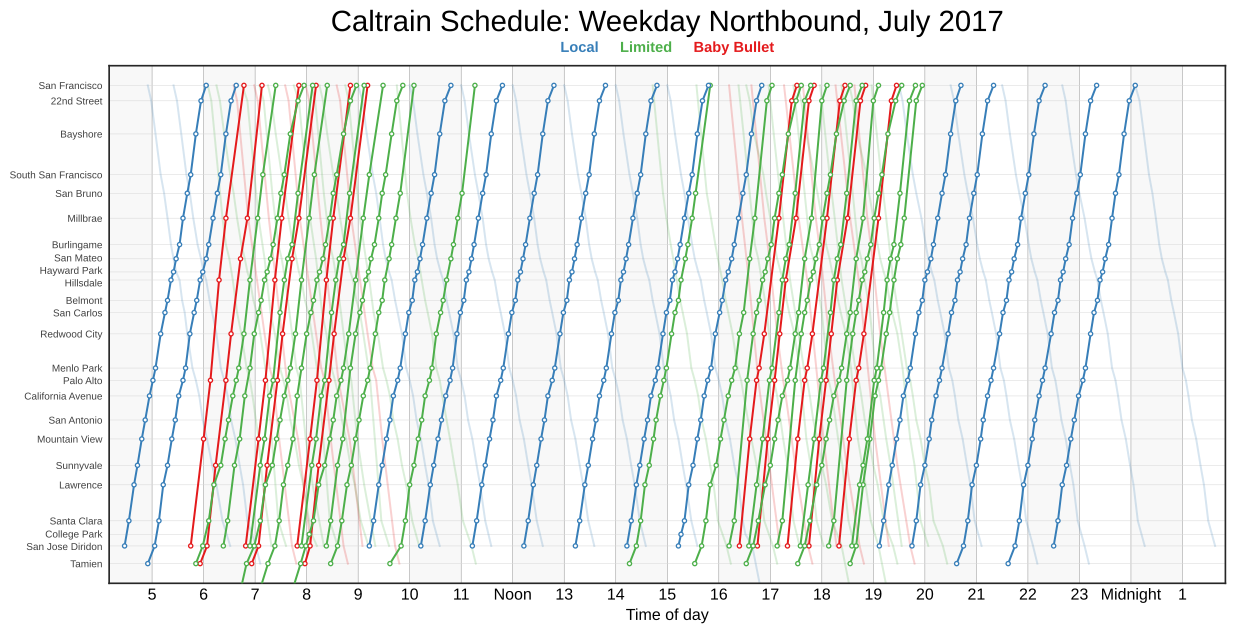
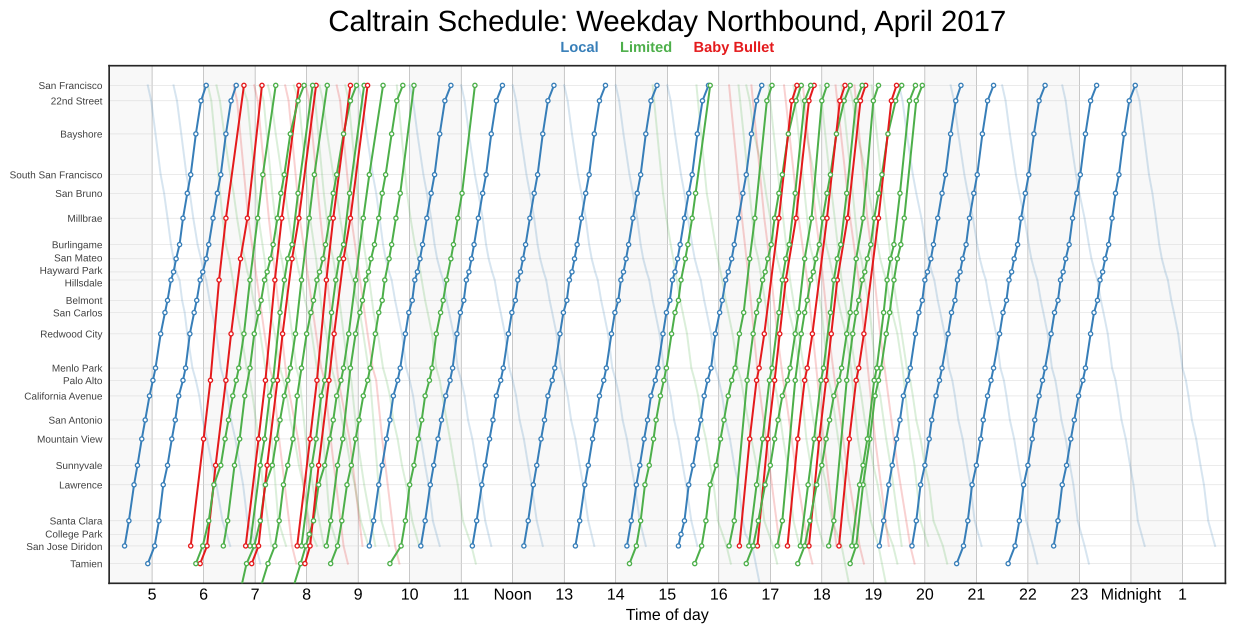
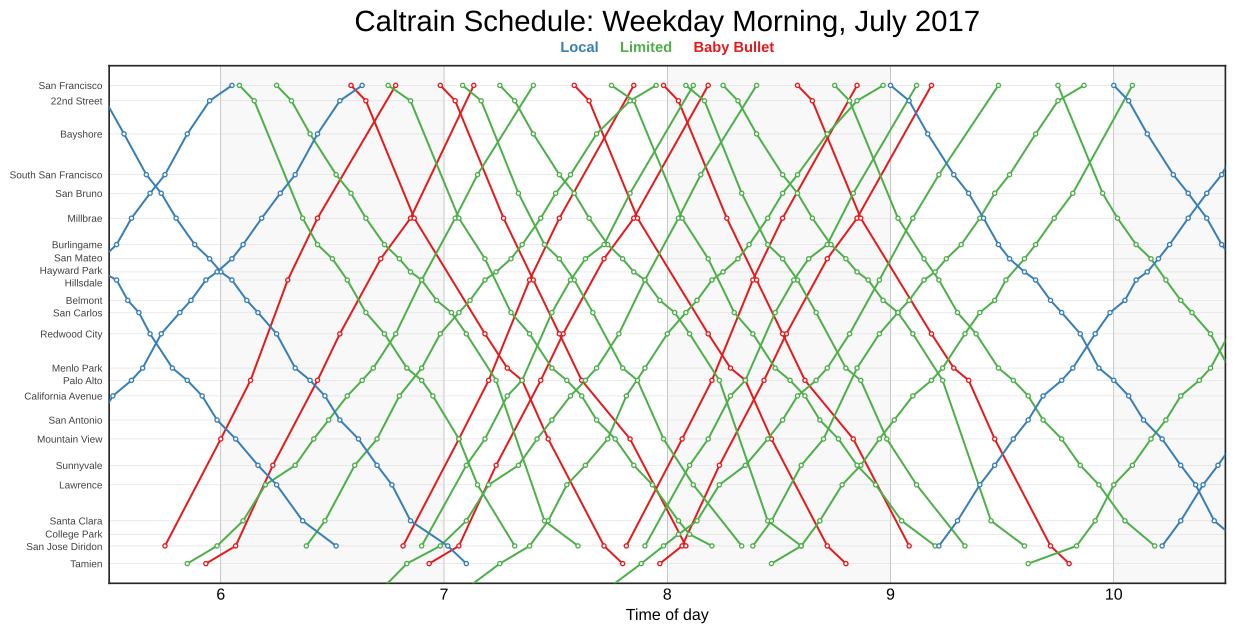
The morning commute schedule has become much more regular! This is clear from the plots, where the 2026 schedule has a simple, repeating pattern, but the 2017 one looks like a tangle. In 2017, there were several different flavors of limiteds and baby bullets (now called express), but they’ve been standardized in 2026 so every limited stops at the same stations, and every express does as well. It makes it much easier to figure out what train you need to take! The starting times have been standardized too, with the local, limited, and express following a clock-face schedule for most of the day, leaving at the same minutes after the hour.
Finally, Caltrain has almost completely stopped using its passing tracks for overtaking. It used to have bullets overtake slower trains regularly, but now it only happens once: when the southbound Express 506 passes Local 108 at about 08:20 near Diridon.
Weekend
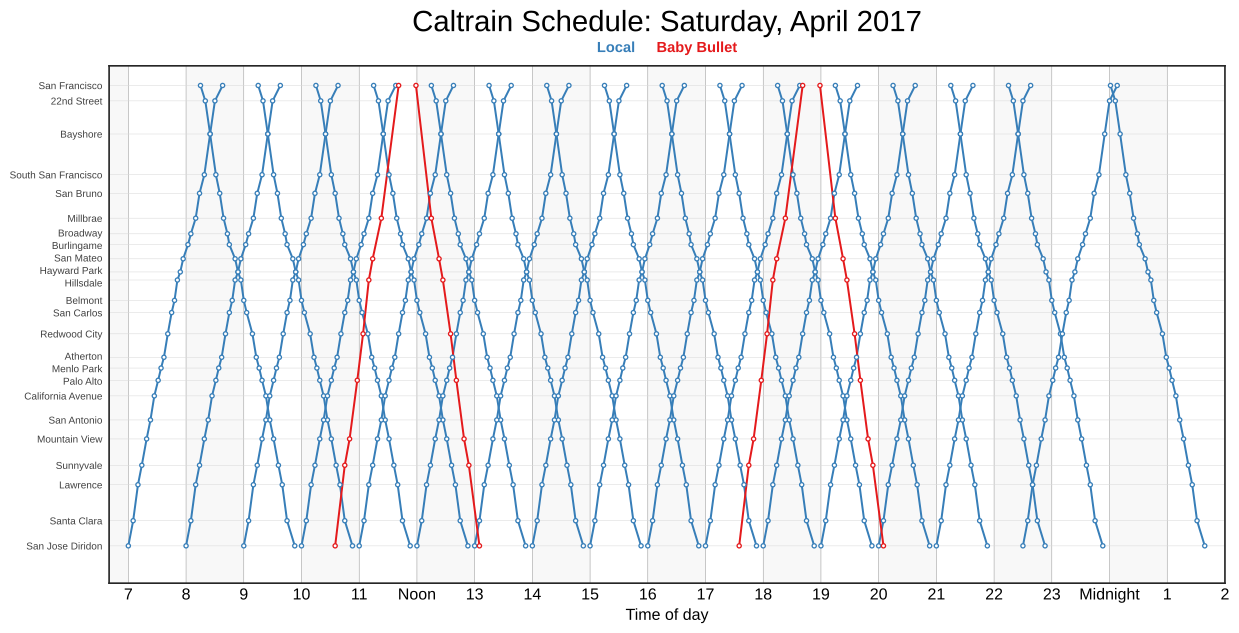
Finally, the weekend is drastically different. For example, see Saturday:
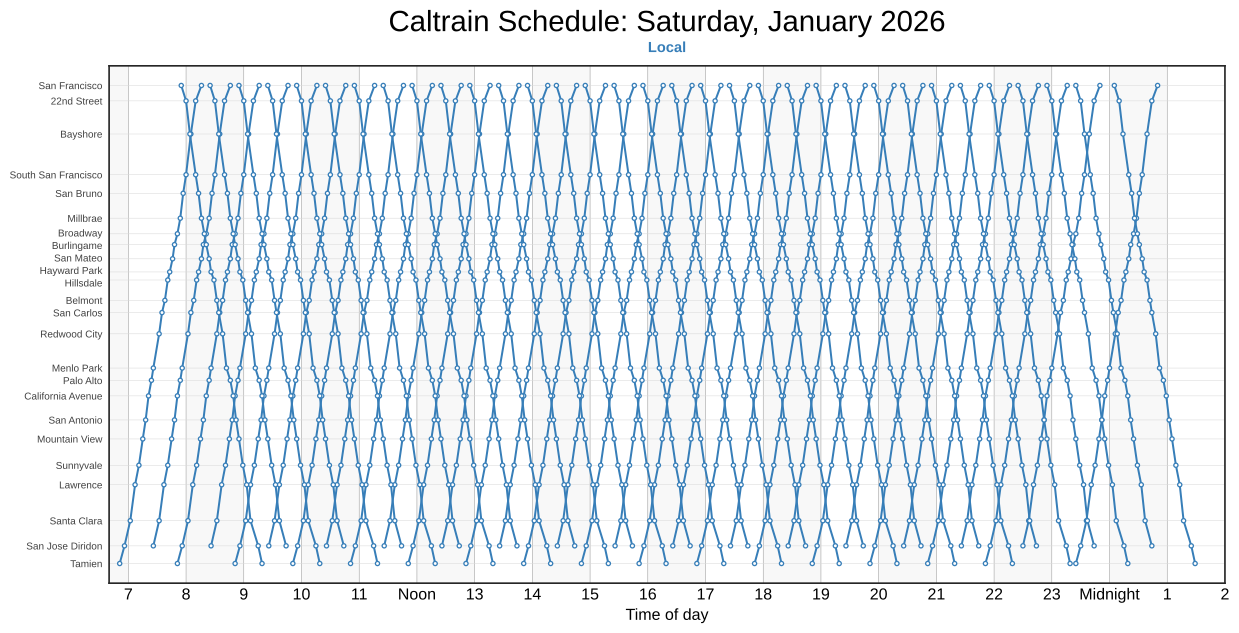
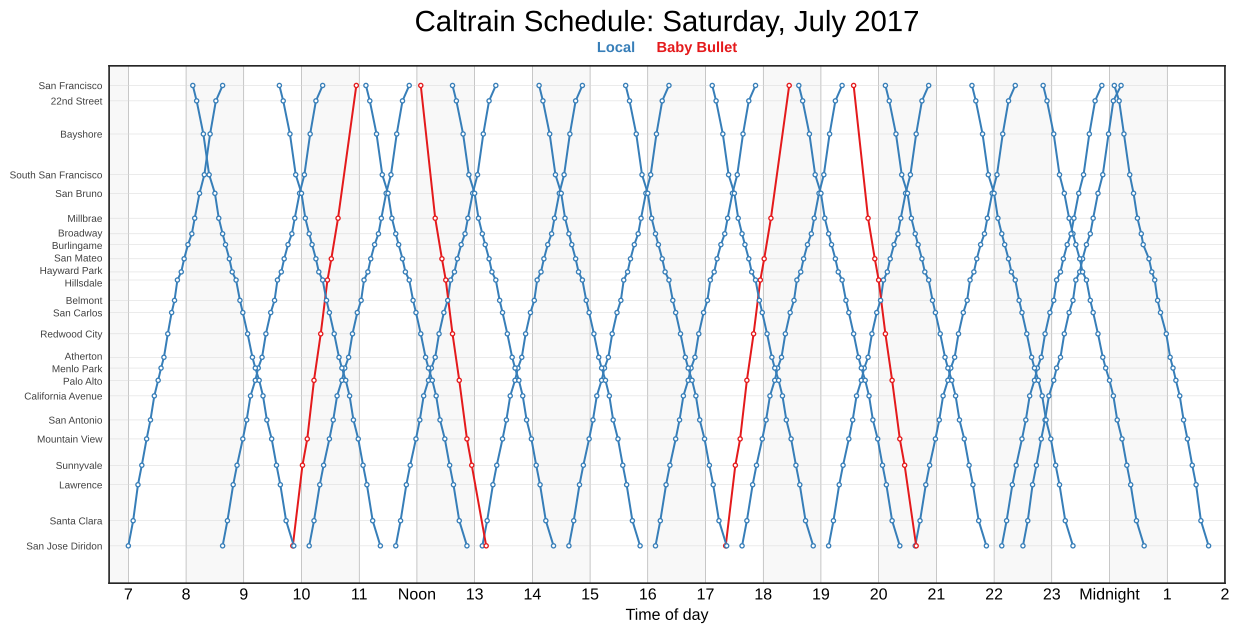
Wow! Double the number of trains! But in exchange we lose the express.
Electricity
What allows all these changes? Electricity! The new electric trains accelerate faster than the old diesel locomotives. This lets them make the trip in less time, or stop in more places and still beat out the old trains. For example, compare the new local train (solid blue line) with the old one (dashed):
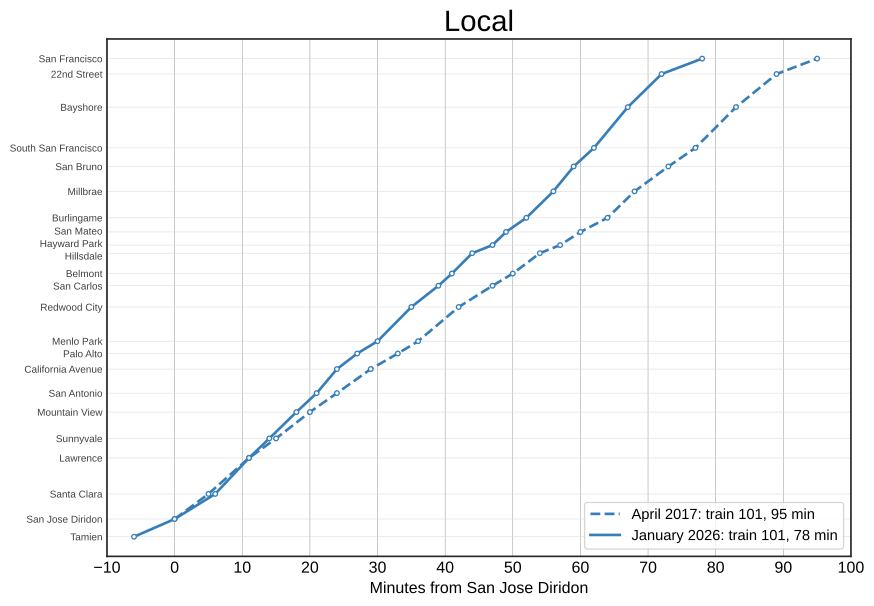
Same number of stops, but making the trip in 78 minutes instead of 95: 17 whole minutes faster! The limited is just as drastic:
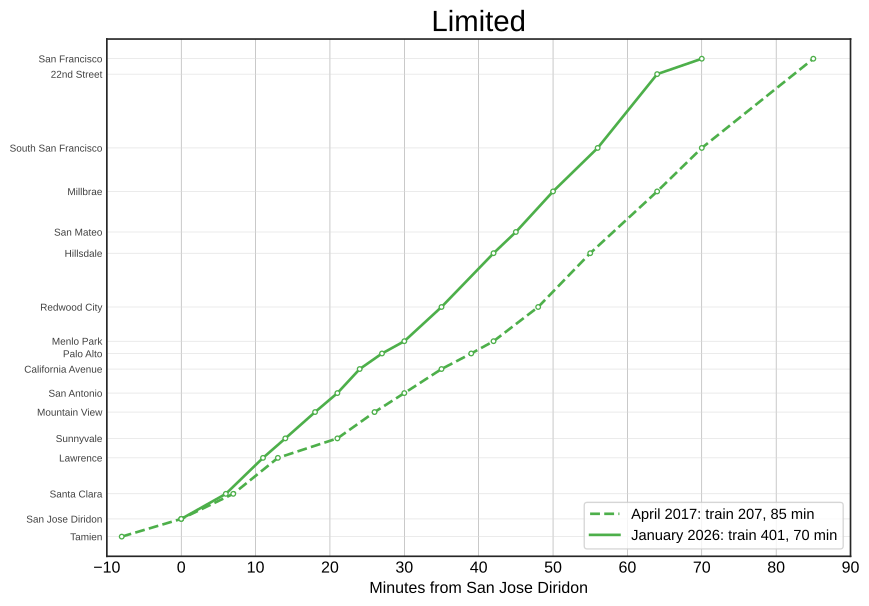
Here I matched two trains with similar stop patterns, since 2017’s limiteds varied from train to train. Notice the new train is 15 minutes faster and makes more stops between Diridon and San Francisco! Finally, the express:
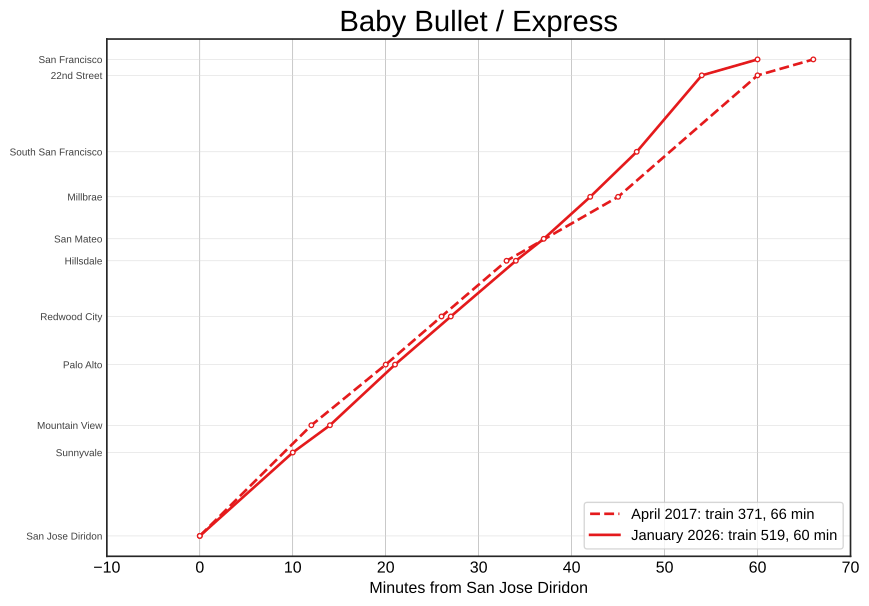
The express shows the least improvement, actually running slower for the first part of the trip—but again, with more stops!—before making it up in the end to finish 6 minutes faster.
All the Plots
I made far more plots than I could fit in this post. Here is every one:
| Chart | January 2026 | July 2017 | April 2017 |
|---|---|---|---|
| Weekday | SVG | SVG | SVG |
| With Gilroy | SVG | SVG | SVG |
| Northbound | SVG | SVG | SVG |
| Southbound | SVG | SVG | SVG |
| Morning commute | SVG | SVG | SVG |
| Evening commute | SVG | SVG | SVG |
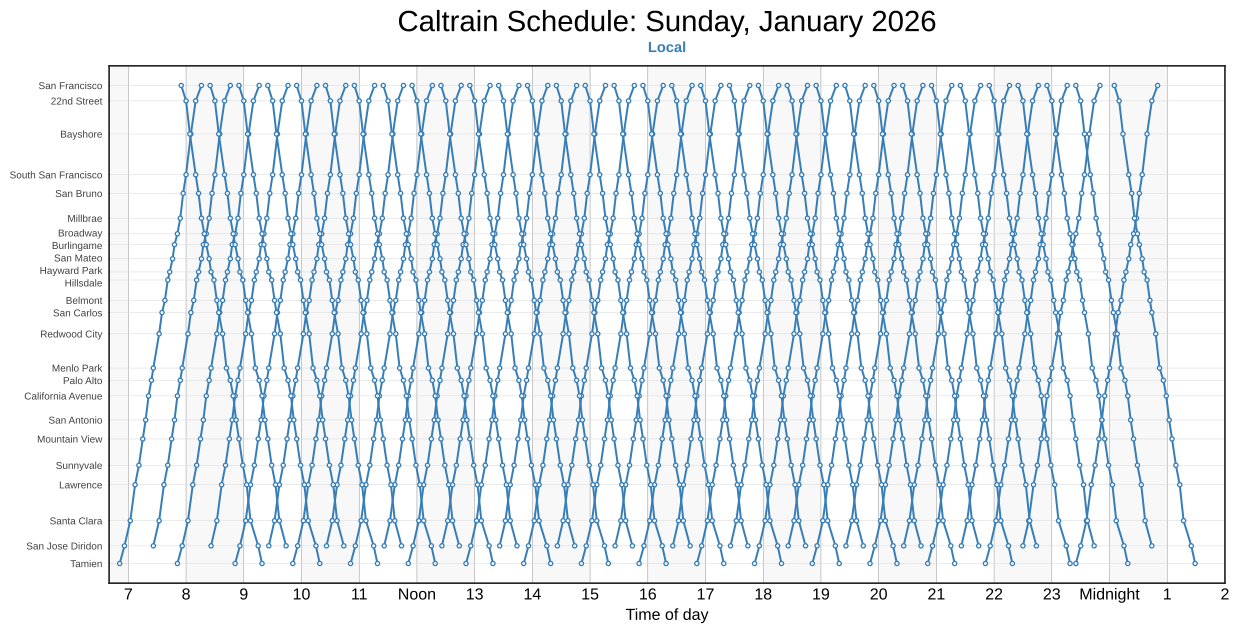
| Saturday | SVG | SVG | SVG |
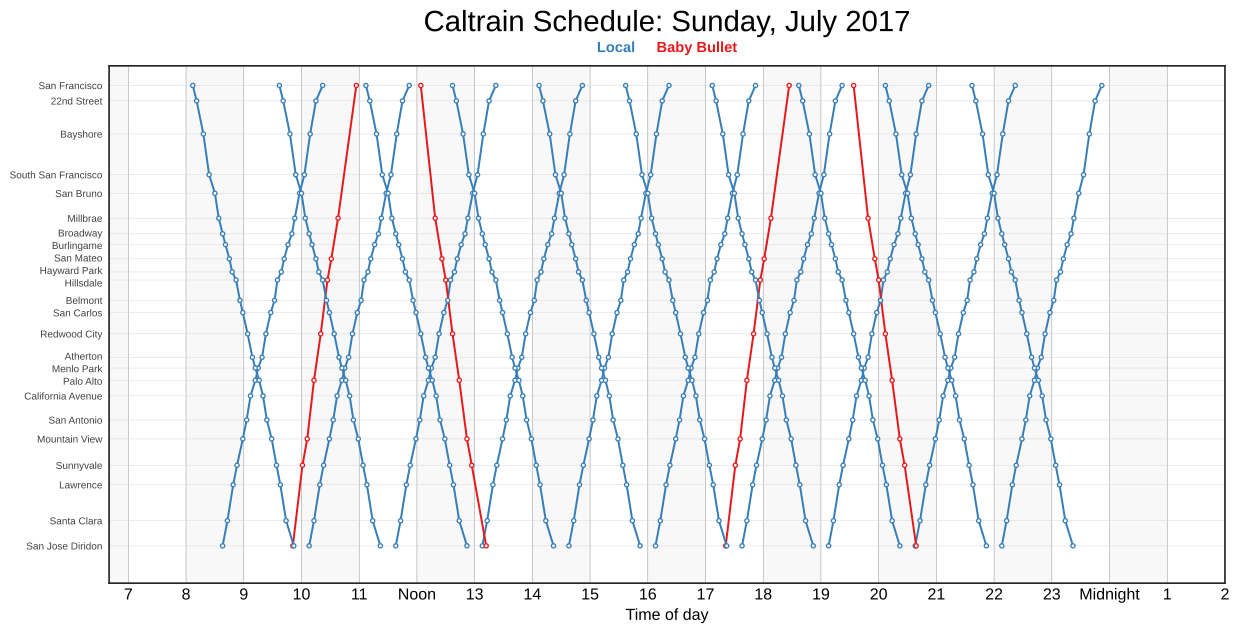
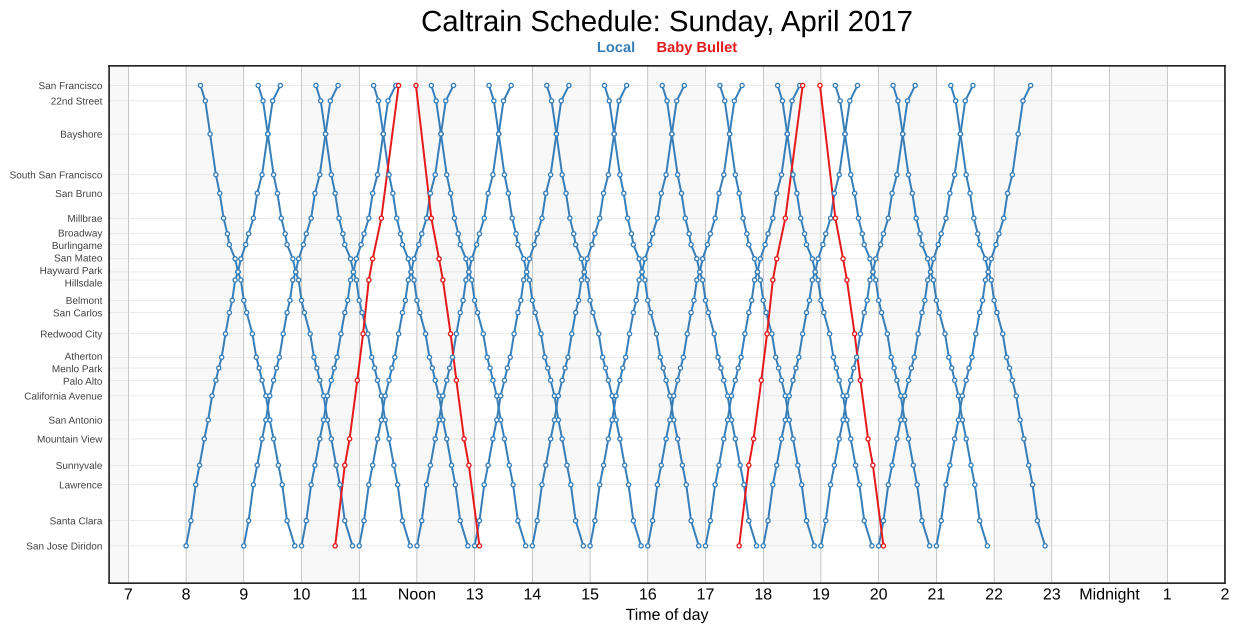
| Sunday | SVG | SVG | SVG |
Other Writings on Caltrain
If you enjoyed this article, here are all the other articles I wrote about Caltrain!
-
 Updated Caltrain Visual Schedule
In July, Caltrain updated their weekend schedule to allow time to do track work, so I updated my Marey/Ibry/Serjev visual schedules to see how it changed! -
 Caltrain Visual Schedule
In 1878, Marey published a famous visual train schedule based on work by Ibry. What would it look like for Silicon Valley's Caltrain? Come find out!
-
I had put off updating these plots because, even though all the code was written, getting the new data, adjusting the code to handle any schema changes, and then tweaking the plot layout were tedious. But now that AI is so capable, I decided to see if Opus 5.5 could do the job with a simple prompt:
It’s time to update the Caltrain plots. See:
- https://alexgude.com/blog/caltrain-visual-schedule.md
- https://alexgude.com/blog/caltrain-visual-schedule-updates.md
Create a library in this folder to do it and generate the same set of plots for the newest schedule.
And 5 minutes later I had them. It took a few more turns of tweaking to get them ready to publish, but the tedium was gone. Another example of how LLMs make Python (and most other code) free now. ↩