# The Fall of Hyperion
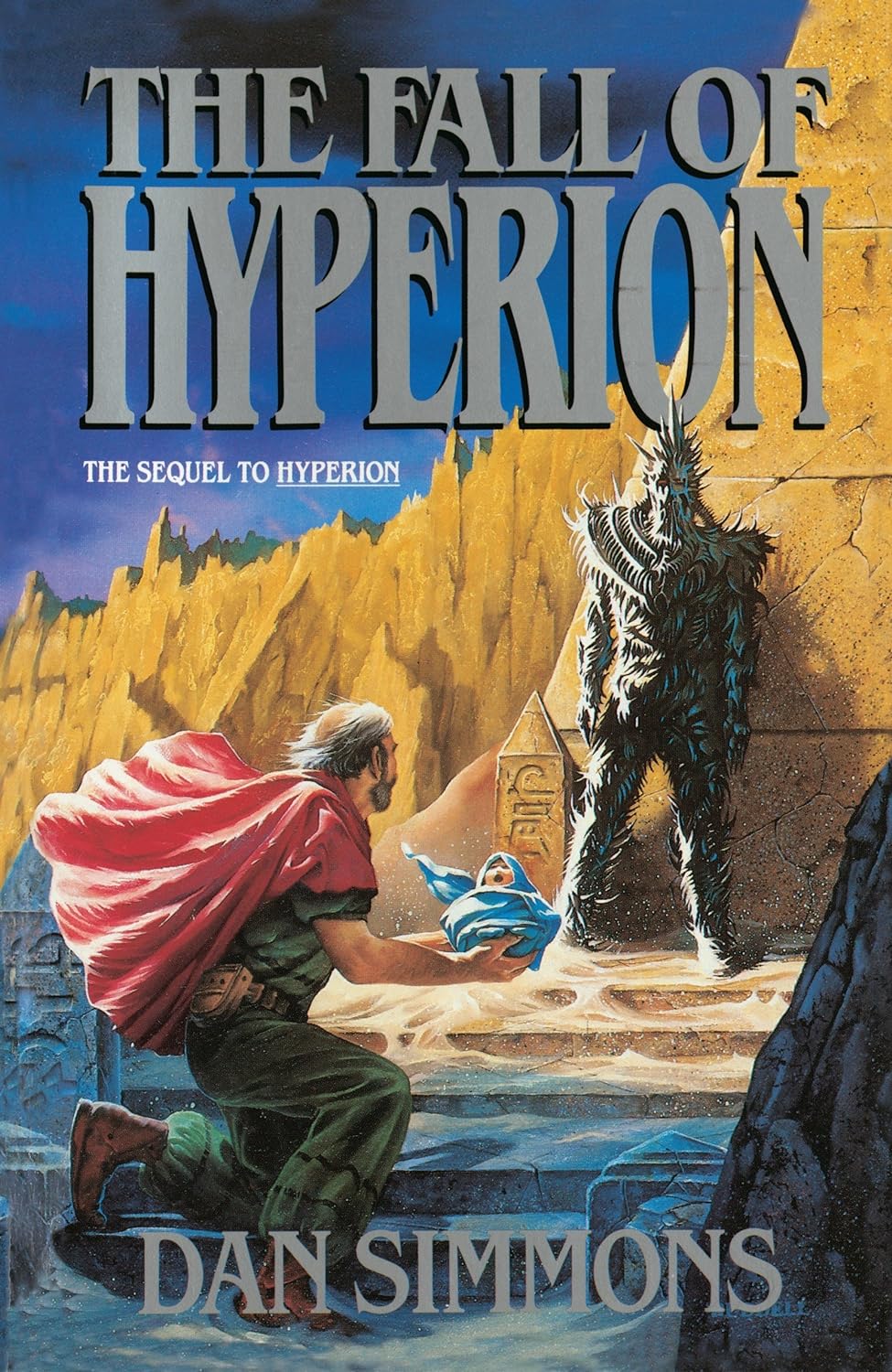
by [Dan Simmons](/books/authors/dan_simmons/)
Book 2 of [Hyperion Cantos](/books/series/hyperion_cantos/)
Awards: [Locus](/books/by-award/#locus-award), [2025 Favorites](/blog/favorite-books-of-2025/)
★★★★★
## Review
The Fall of Hyperion, by Dan Simmons, is the second book in the
Hyperion Cantos, but really it's the second
half of [_Hyperion_](/books/hyperion/). It brings the seven pilgrims' story to an
end and depicts the war between the TechnoCore, the Ousters, and the Hegemony.
I loved The Fall of Hyperion when I [first read it][first_read], even more so than
[_Hyperion_](/books/hyperion/), because it tells a much simpler story. It has space battles,
the Soldier fighting the Shrike, and answers to every mystery. It doesn't
require the kind of close reading that the first one does to really enjoy it.
[first_read]: /books/the_fall_of_hyperion/review-2023-10-27/
On this second read-through, I recognized [_Hyperion_](/books/hyperion/) for the epic
masterpiece it is, on the same level as [Wolfe](/books/authors/gene_wolfe/)'s [The Book of the New Sun](/books/series/the_book_of_the_new_sun/), Herbert's Dune, or Tolkien's The Lord of the Rings. But my
opinion of The Fall of Hyperion didn't change. It's still great, but it didn't
reveal the same level of hidden depth.
### Themes
The Fall of Hyperion follows the themes and structure of its namesake, John Keats's
_The Fall of Hyperion: A Dream_. Just as the narrator of the poem falls asleep and dreams of the
aftermath of the [Titanomachy][titanomachy], the cybrid Joseph Severn dreams
of the fall of the Hegemony from a distance.
[titanomachy]: https://en.wikipedia.org/wiki/Titanomachy
The character Moneta takes her role directly from the poem. In Keats's poem, she is the living archive of the war and the guardian
of the altar. In Simmons's book, she is the
survivor of a war in the far future who brings the memory of it back in time.
In the poem, she points out the difference between a dreamer and a poet: the
dreamer observes the world but does not act, while the poet uses empathy to
provide meaning and heal the world.
The central thesis of The Fall of Hyperion, that suffering is necessary for
enlightenment, comes directly from Keats's poem:
> "None can usurp this height," returned that shade,\
> "But those to whom the miseries of the world\
> Are misery, and will not let them rest.\
> All else who find a heaven in the world,\
> Where they may thoughtless sleep away their days,\
> If by a chance into this fane they come,\
> Rot on the pavement where thou rottedst half."
>
> --- Keats, John. ["An Earlier Version of 'Hyperion'"](https://en.wikisource.org/wiki/The_Poetical_Works_of_John_Keats/An_Earlier_Version_of_%22Hyperion%22) *The Poetical Works of John Keats*. DeWolfe, Fiske & Company. 1884. p. 281.
Simmons applies this idea to civilization itself. The
Hegemony is stagnant because the TechnoCore has made life too easy. This is
juxtaposed against the Ousters, who rejected the TechnoCore's gifts and have
flourished as the true heirs of humanity.
This requirement for suffering determines the outcome of the war in heaven as
well. Through Father Paul Duré, Simmons casts the war as a
race to [Pierre Teilhard de Chardin's][ptdc] [Omega Point][op]---the final
evolution of an evolving god. The machines try to reach this point by creating
a god that is all intellect. But because it cannot suffer, it is destined to
lose to the human god, which unites intellect with empathy via the Void Which
Binds. Severn transitions from dreamer to poet only when he suffers through
the same death as Keats, allowing him to finally act by joining
the empathy aspect of the triune human god.
[ptdc]: https://en.wikipedia.org/wiki/Pierre_Teilhard_de_Chardin
[op]: https://en.wikipedia.org/wiki/Omega_Point
Ultimately, the book follows Keats's theme of "dying into life."
The narrator in _The Fall of Hyperion: A Dream_ feels his death and rebirth as he climbs to the
altar; similarly, the novel's narrator, Joseph Severn, must physically die to
be reborn within the Void. Apollo in Keats's _Hyperion_ is granted godhood through "knowledge enormous", taking in the agonies and
triumphs of the universe, just as the human god is born from uniting intellect
and empathy. We see this cycle everywhere: with Father Duré and Father Hoyt
dying and being reborn through the cruciform parasite, and finally with CEO
Meina Gladstone's choice to destroy the Hegemony.
Gladstone's choice resolves the theme of Abrahamic sacrifice introduced in the
first book. In The Fall of Hyperion, Sol Weintraub realizes that Abraham's test was
not really a test of Abraham, but a test of God, and that blind obedience is
immoral. By reclaiming his own will, he resolves the dilemma. Weintraub
sacrifices Rachel only when _she_ asks for it. Gladstone arrives at the same
solution: she sacrifices the Hegemony not because it is demanded, but because
she chooses to take the sin upon herself, freeing humanity and allowing them
to die into life.
### Story
[_Hyperion_](/books/hyperion/)'s structure is so compelling, with each pilgrim's story as a
pastiche of a different genre. When you layer in the themes and references to
Keats's work, it becomes a masterpiece. The Fall of Hyperion feels
like a pale imitation. It's still great, but not transcendental.
It also suffers in the way [Wolfe](/books/authors/gene_wolfe/)'s [_The Urth of the New Sun_](/books/the_urth_of_the_new_sun/) does: it explains
every mystery. The cruciform parasites were intended to do this, the Tree of
Thorns was created to do that, etc., etc. It leaves the impression that the
world is a little too neat, too planned out.
That said, the plotting and pacing are on point. There are two twists that
both hit hard. The first is when the other Ouster swarms attack the Web,
indicating they must have been launched hundreds of years ago. The second
comes when the swarms are revealed to be TechnoCore false-flag operations, and
the Ousters are revealed to be humanity's true descendants rather than
barbarians.
The Fall of Hyperion reminded me of a few other works in its darker themes. The
Shrike's Tree of Pain being imaginary, with torture fed into the victims'
heads via a shunt, is the same idea as in [Banks](/books/authors/iain_m_banks/)'s [_Surface Detail_](/books/surface_detail/), where civilizations use simulated hells to punish sinners.
The planet-wide inferno on God's Grove was like the tsunamis of flame in [_The Player of Games_](/books/the_player_of_games/). Gladstone sacrificing billions to save humanity
reminds me of the choice Ozymandias makes in Moore and Gibbons's _Watchmen_, although Ozymandias builds a lie whereas Gladstone exposes the
truth. The struggles of the Catholic Church during civilizations collapse is
like [Miller](/books/authors/walter_m_miller_jr/)'s [_A Canticle for Leibowitz_](/books/a_canticle_for_leibowitz/). Both this book and [El-Mohtar](/books/authors/amal_el-mohtar/) and [Gladstone](/books/authors/max_gladstone/)'s [_This Is How You Lose the Time War_](/books/this_is_how_you_lose_the_time_war/) deal with
a war being fought over possible futures.
Some of the details were similar to other books as well. The Core references
Asimov's [Three Laws of Robotics][three_laws] from _I, Robot_. The navy's use of a star system in the farcaster network as a DMZ is an
idea later used by [Taylor](/books/authors/dennis_e_taylor/) in [_Not Till We Are Lost_](/books/not_till_we_are_lost/), and is similar to how
Basilisk is used in [Weber](/books/authors/david_weber/)'s [_On Basilisk Station_](/books/on_basilisk_station/). Finally, the
cruciform glowing on the labyrinth walls reminded me of the glowing Harmonium
aliens in the caves of Mercury in [Vonnegut](/books/authors/kurt_vonnegut/)'s [_The Sirens of Titan_](/books/the_sirens_of_titan/).
[three_laws]: https://en.wikipedia.org/wiki/Three_Laws_of_Robotics
The last time I read this book, I stopped here and didn't finish the rest of
the the Hyperion Cantos. This time I intend to continue on through [_Endymion_](/books/endymion/) and [_The Rise of Endymion_](/books/the_rise_of_endymion/), even though I hear each one is worse than the
last. I'm hoping I've heard incorrectly!
## Reviews that mention _The Fall of Hyperion_
- [_Endymion_](/books/endymion/)
- [_Exit Strategy_](/books/exit_strategy/)
- [_Hyperion_](/books/hyperion/)
- [_Monday Begins on Saturday_](/books/monday_begins_on_saturday/)†
- [_The Moon Is a Harsh Mistress_](/books/the_moon_is_a_harsh_mistress/)†
- [_On Basilisk Station_](/books/on_basilisk_station/)
- [_The Rise of Endymion_](/books/the_rise_of_endymion/)
- [_This Is How You Lose the Time War_](/books/this_is_how_you_lose_the_time_war/)
† _Mentioned via a link to the series._
## Previous Reviews
- [_The Fall of Hyperion_](/books/the_fall_of_hyperion/review-2023-10-27/) by [Dan Simmons](/books/authors/dan_simmons/) --- ★★★★★
## Related Books
- [_Hyperion_](/books/hyperion/) by [Dan Simmons](/books/authors/dan_simmons/) --- ★★★★★
- [_Endymion_](/books/endymion/) by [Dan Simmons](/books/authors/dan_simmons/) --- ★★★★☆
- [_The Rise of Endymion_](/books/the_rise_of_endymion/) by [Dan Simmons](/books/authors/dan_simmons/) --- ★★★★☆