# The Darfsteller
by [Walter M. Miller Jr.](/books/authors/walter_m_miller_jr/)
Awards: [Hugo](/books/by-award/#hugo-award)
★★★☆☆
## Review
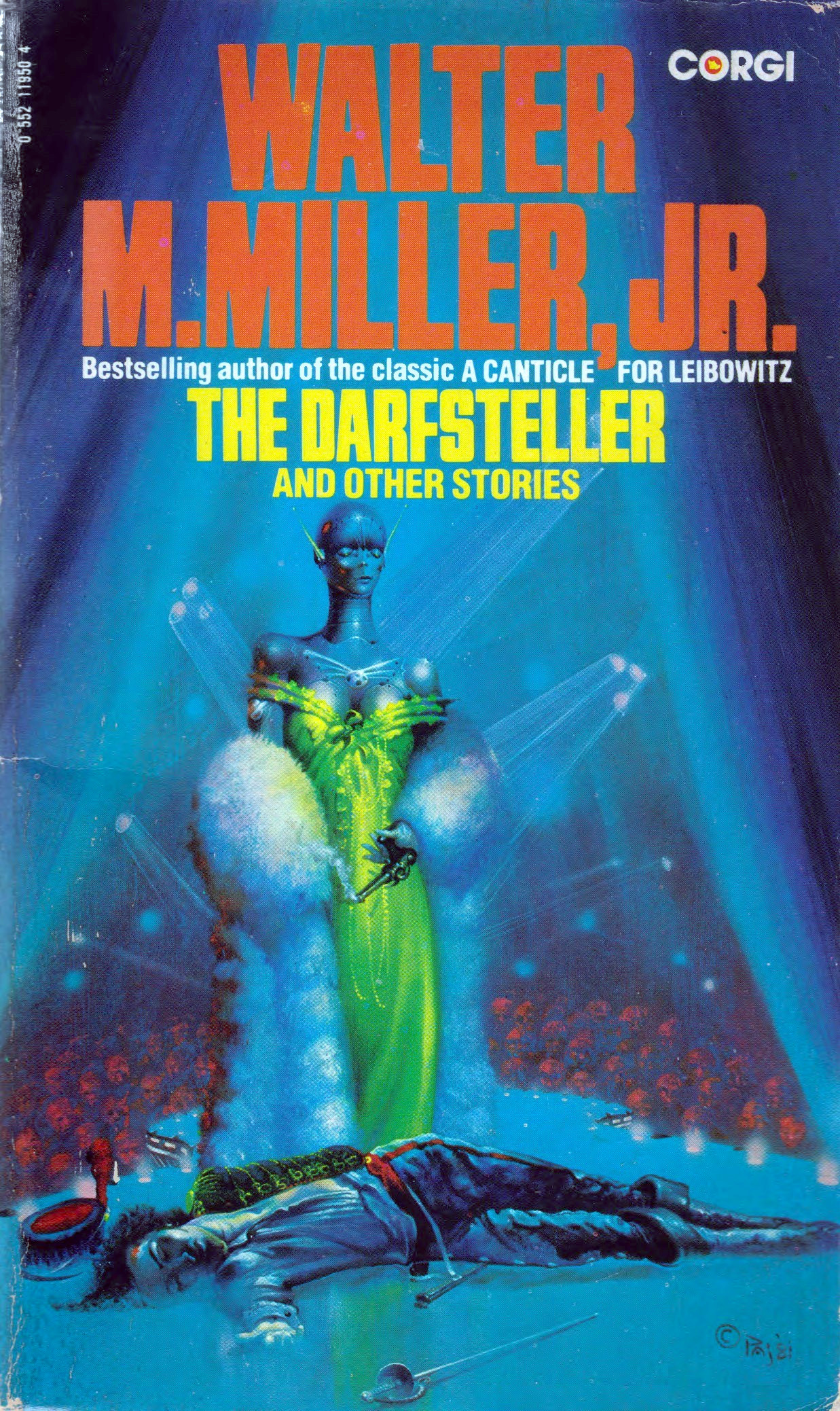
The Darfsteller, by Walter M. Miller Jr., is a Hugo Award-winning
novelette about the obsolescence of the human artist. It follows Ryan
Thornier, a former stage idol reduced to working as a janitor in a theater now
run entirely by robots and an AI director, as he schemes to take the stage one
last time.
In the future of The Darfsteller, actors have been replaced on the stage by
robots. An AI Maestro controls them, adjusting the plays on the fly in
response to the audiences' reactions. Audiences prefer the robotic plays
because they are easier to understand and less challenging to their views.
Against this backdrop, three former actors---Ryan Thornier, Mela Stone, and
Jade Ferne---try to figure out what to do with their lives.
Thornier is obsessed with his former life and resorts to mopping the theater
floors in a bid to stay close to the stage. When he grows tired of it, and is
on the verge of being replaced by a robot yet again, he plots to sabotage the
play and give himself one last chance at a starring role. Stone, on the other
hand, has accepted the complete commercialization of her art. She sells her
personality rights, allowing robots to be made in her image. Ferne was never
popular enough for that kind of contract, so she works producing robotic plays
instead.
I expected Miller, as an artist, to take Thornier's side.
But he doesn't, not really. He portrays Thornier as driven by vanity and
fighting hopelessly against the inevitable. His inability to respond to the
audience and move on makes him more machine-like than the Maestro. Nor does
the author condemn Stone and Ferne as collaborators. Even the robots and their
creator aren't villains. If anyone is at fault, it is the audience that has
learned to prefer unchallenging plays. But there too, Miller admits this is the reality of how commercial art must be: controlled
entirely by economics.
At the end, the author argues that specialists are doomed to be replaced. Only
those who keep adapting survive. As one character put it: "The specialty of
creating new specialties. Continuously. Your own. [...] More or less a
definition of Man, isn't it?" It reminds me of [Heinlein](/books/authors/robert_a_heinlein/)'s famous
assertion that "Specialization is for insects".[^quote] Although Miller argues more for specializing in _being yourself_ while
[Heinlein](/books/authors/robert_a_heinlein/) argues for generalization, both have identified
stagnation as the problem.
[^quote]:
From _Time Enough for Love_:
> A human being should be able to change a diaper, plan an invasion,
> butcher a hog, conn a ship, design a building, write a sonnet, balance
> accounts, build a wall, set a bone, comfort the dying, take orders, give
> orders, cooperate, act alone, solve equations, analyze a new problem,
> pitch manure, program a computer, cook a tasty meal, fight efficiently,
> die gallantly. Specialization is for insects.
Science fiction often imagines robots replacing manual labor and AI taking
over numerical jobs. A common conceit is that creativity is the one human
trait machines can't emulate, and it is what keeps us relevant. The Darfsteller flips that. Instead, it suggests that creative work will be the first thing
we automate. Seventy years later, with the rise of [generative AI][gen_ai],
that is exactly what we're seeing. Like current artists, the actors in this
story react in different ways: [some push back][ai_art] against it while
others give in. Miller's answer is bleak: in
commercial art, what makes money wins. The result feels surprisingly
prescient.
[gen_ai]: /topics/generative-ai/
[ai_art]: /blog/ai-artists-and-technology/
The fear of automating creative work is explored in a few other stories, and
writers---being writers---have mostly focused on the written word: Dahl's _The Great Automatic Grammatizator_ features a machine that generates
best-sellers automatically; Leiber's _The Silver Eggheads_
imagines authors selling their names to brand computer-written books; Lem's _Trurl's Electronic Bard_ centers on a machine that writes
poetry better than humans, driving them to suicide; Ballard's _Studio 5, The Stars_ likewise has a poetry machine. [Vonnegut](/books/authors/kurt_vonnegut/)'s
_Player Piano_ explores a world where everything is automated. [Simmons](/books/authors/dan_simmons/)'s [_Hyperion_](/books/hyperion/) tackles the commercialization and
debasement of art, where Silenus's brilliant Cantos flops while his pulpy The Dying Earth sells billions.
Up next is [Arkady](/books/authors/arkady_strugatsky/) and [Boris Strugatsky](/books/authors/boris_strugatsky/)'s [_Monday Begins on Saturday_](/books/monday_begins_on_saturday/), and then I
really should start [_This Is How You Lose the Time War_](/books/this_is_how_you_lose_the_time_war/) for my book club.
## Reviews that mention _The Darfsteller_
- [_A Canticle for Leibowitz_](/books/a_canticle_for_leibowitz/)
- [_There Is No Antimemetics Division_](/books/there_is_no_antimemetics_division/)
## Related Books
- [_A Canticle for Leibowitz_](/books/a_canticle_for_leibowitz/) by [Walter M. Miller Jr.](/books/authors/walter_m_miller_jr/) --- ★★★★☆
- [_The Rise of Endymion_](/books/the_rise_of_endymion/) by [Dan Simmons](/books/authors/dan_simmons/) --- ★★★★☆
- [_Endymion_](/books/endymion/) by [Dan Simmons](/books/authors/dan_simmons/) --- ★★★★☆