# Snow Crash
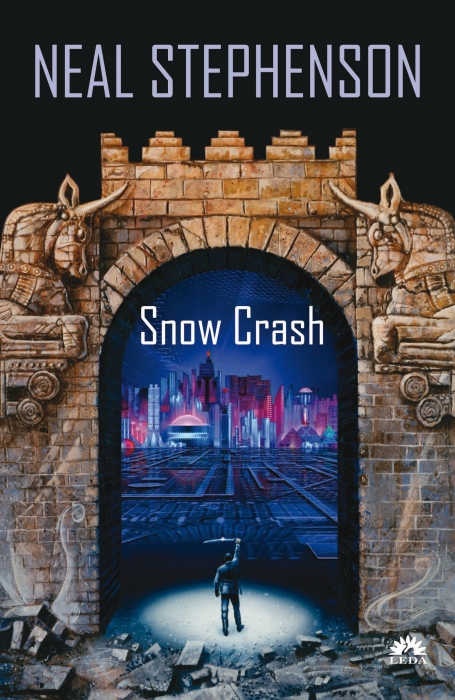
by [Neal Stephenson](/books/authors/neal_stephenson/)
★★★★☆
## Review
_Snow Crash_, by Neal Stephenson,
is a satirical cyberpunk novel set in a near-future America where the federal
government has collapsed and everything---pizza, religion, neighborhoods,
national defense---is run by competing franchises. It follows Hiro
Protagonist, a hacker and pizza delivery driver, and Y.T., a teenage skateboard courier, as they uncover a
conspiracy to reprogram the human mind.
I first read _Snow Crash_ in college and didn't get it. It had cool ideas,
great writing, some authentic weirdness. The problem was I had no context to
place it within the canon. I'd read a lot of science fiction growing up, but
it was mostly golden-age authors like [Clarke](/books/authors/arthur_c_clarke/), [Heinlein](/books/authors/robert_a_heinlein/), and Bradbury. I had completely missed New
Wave authors like [Brunner](/books/authors/john_brunner/), and probably hadn't even heard of
cyberpunk. This time I decided to fix that, reading [Gibson](/books/authors/william_gibson/)'s [_Neuromancer_](/books/neuromancer/) first. I'm glad I did. Stephenson makes direct
references to [_Neuromancer_](/books/neuromancer/)---the same 'sarariman' Rōmaji, a drone
decapitation, Rife's primary-colored cyberspace---but the real connection is
thematic. [_Neuromancer_](/books/neuromancer/) is about what makes us human and how we strip it
away for power. This book responds that it's even simpler: you don't need to
jack in or have your humanity cut away and replaced with chrome to lose
yourself. Commodified, homogenized, commercialized culture does it for you
already.
### Culture Franchised
_Snow Crash_ is about a mind-virus that changes how people behave, makes
them unconscious zombies; it's about the metaverse; it's about the replacement
of government by franchises; it's about high-speed pizza delivery; it's about
depleted uranium miniguns and smart wheels and katanas. That's the text, but
all of it is Stephenson defamiliarizing 80s and 90s
consumerism, exaggerating it so you notice what is already there.
[Gibson](/books/authors/william_gibson/) left room for organic subcultures to survive next to the
towering zaibatsu, like the Panther Moderns or the Rastafarians or even the
console cowboys. Stephenson has done away with all that.
Culture in _Snow Crash_ comes top-down, packaged in a franchise container
and sold the same everywhere. Your ethnicity? Turned into a stereotype-filled
franchise like Mr. Lee's Hong Kong or NarcoColombia. Your neighborhood? A
burbclave patterned on apartheid South Africa with a copy/paste HOA
constitution. Your religion? Televangelism-cum-conspiracy theory with a
subscription plan. Even the pirate gangs have stolen their identity from
Western and Kung Fu movie stars. The one thing that almost escaped capture was
the Metaverse. It started as a bottom-up culture built by hackers, but even it
got taken over and turned into a strip mall with millions of default Brandy
and Clint avatars. The last bastion has become a product.
### The Writing
What I loved about this book is how Stephenson weaves
Mesopotamian history, neurolinguistics, Pentecostal glossolalia, and
fiber-optic cable into a conspiracy that slowly comes together: the
implication that culture has _always_ been franchised, always pushed from the
top down, with the Sumerian [_Me_][me] as the first example. Unraveling the
plot is what kept me hooked. The most similar experience I can think of
is---I'm sorry, I'm sorry!---Dan Brown's _Angels & Demons_ and _The Da Vinci Code_.
[me]: https://en.wikipedia.org/wiki/Me_(mythology)
Stephenson's prose fits the book perfectly. Stephenson uses [Vonnegut](/books/authors/kurt_vonnegut/)'s style of playing obvious
absurdities straight to highlight the contradiction; it reinforces the theme
_and_ is funny! The first chapter is a wonderful example: the narrator
describes in over-the-top prose how fast Hiro's car is, how powerful his gun
is, how he is a master with his katana, at driving, at delivering... pizza. He
drives his badass car into a pool. He lives in a storage container. He's a
master sword fighter in video games.
But _Snow Crash_ has plenty of faults, the biggest of which it shares with
Dan Brown. I like books where you have to think to piece things
together, like [_Hyperion_](/books/hyperion/) with all its intertextuality, or [_Echopraxia_](/books/echopraxia/) where the narrator has no idea what's actually happening. _Snow Crash_
doesn't get there. Just when you start piecing things together, Hiro will
pause and explain the entire thing to you, or worse, the librarian program
will lecture him about it for 10 pages. The exposition drags and slows down
the plot. And as is Stephenson's habit, the story
ends abruptly, but it didn't bother me as much this time because I was ready
for it.
And then there is the scene where fifteen-year-old Y.T. has enthusiastic
sex with Raven, a man in his forties. It creeped me out when I first read it
and it creeped me out this time too. It's a lot of the reason I didn't like _Snow Crash_ originally.
### Other Works
_Snow Crash_ reminded me of some other works. The idea that humans were
controllable because they lacked consciousness, and that Enki's defense was to
grant it to them, is the opposite of the idea in [Watts](/books/authors/peter_watts/)'s [_Blindsight_](/books/blindsight/) where consciousness is an evolutionary dead end. Ideas that
spread and infect people are explored in both [Vinge](/books/authors/vernor_vinge/)'s [_A Fire Upon The Deep_](/books/a_fire_upon_the_deep/), where the Blight is transmitted as infected
information, and [qntm](/books/authors/qntm/)'s [_There Is No Antimemetics Division_](/books/there_is_no_antimemetics_division/), where
antimemes are ideas that can't be thought and have power over people. Cops
showing advertisements, jails run by big-box stores, countries with
subscriptions for citizenship, and a nickel-and-dime religion are right out of
[Dick](/books/authors/philip_k_dick/)'s [_Ubik_](/books/ubik/). The pairing of Hiro and Da5id as hackers who
started off small together, one hitting it big while the other didn't, mirrors
Bishop and Cosmo from _Sneakers_. And Y.T., herself a harpooner, makes
several references to Melville's _Moby Dick_, including the
unintentionally apt observation that Ahab "just didn't know when to let go";
she means of the harpoon, but she's describing both Ahab and Raven's obsession
with revenge.
Some smaller references: motorcycles in the Metaverse are out of _Tron_.
The freighters full of refugees appear again in [Winters](/books/authors/ben_h_winters/)'s [_Countdown City_](/books/countdown_city/). The idea of compartmentalizing information in the brains of
your employees was used in _Severance_. Rife's private aircraft carrier is
out of [Brunner](/books/authors/john_brunner/)'s [_Stand on Zanzibar_](/books/stand_on_zanzibar/). And the boat chase
through the raft reminded me of the chase through the floating city in [Williams](/books/authors/walter_jon_williams/)'s [_City on Fire_](/books/city_on_fire/).
With a lot more context, I enjoyed _Snow Crash_ much more than my first
read-through. There are complicated ideas that come out best when you
understand what they're responding to. It's something I appreciate now: the
best sci-fi rewards a closer read. I look forward to revisiting some of Stephenson's other works. I remember really enjoying _Anathem_ when I read it in grad school, and I've never read his more famous
_Cryptonomicon_.
## Reviews that mention _Snow Crash_
- [_The Moon Is a Harsh Mistress_](/books/the_moon_is_a_harsh_mistress/)
- [_Neuromancer_](/books/neuromancer/)
- [_Stand on Zanzibar_](/books/stand_on_zanzibar/)
## Related Books
- [_Neuromancer_](/books/neuromancer/) by [William Gibson](/books/authors/william_gibson/) --- ★★★★★: Neuromancer, by William Gibson, is the first book in the Sprawl series, and one of the founding texts of cyberpunk. In it, Case, a hacker who can’t jack in anymore, and street samurai Molly Millions are hired by a mysterious ex-special forces agent to pull off a heist.
- [_Hyperion_](/books/hyperion/) by [Dan Simmons](/books/authors/dan_simmons/) --- ★★★★★: Hyperion is Dan Simmons’s masterpiece. It is the first book in his Hyperion Cantos. It follows seven pilgrims as they travel to the Time Tombs on Hyperion to petition the Shrike. Along the way, each tells their own story, weaving together history, myth, and prophecy to tell of the impending downfall of man.
- [_Echopraxia_](/books/echopraxia/) by [Peter Watts](/books/authors/peter_watts/) --- ★★★★★: Echopraxia, by Peter Watts, is the second book in the Firefall series, unfolding at roughly the same time as Blindsight. It follows parasitologist Daniel Brüks, who gets unwillingly dragged into a conflict between multiple transhuman factions, travels to the Icarus station orbiting the sun, and eventually back to Earth.